1957 Dual-Ghia Convertible
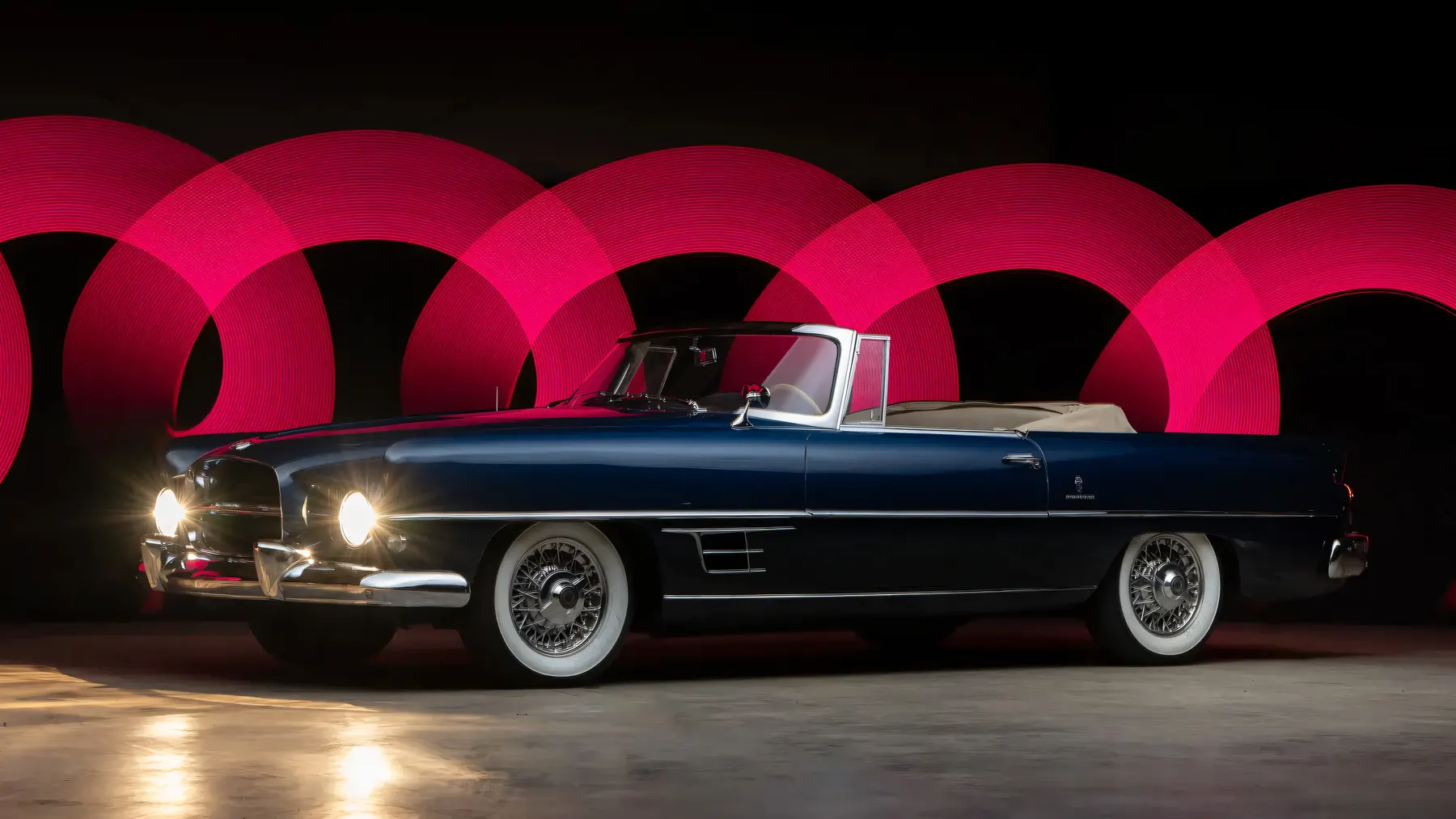
The story of the Dual-Ghia Convertible begins not on a design studio floor but on a Detroit show circuit in 1953, when a concept car called the Dodge Firearrow was drawing the kind of crowds that production-line Chevrolets could only dream of. Virgil Exner, Chrysler’s visionary head of advanced styling, had commissioned Carrozzeria Ghia of Turin to translate his sketches into rolled aluminium and hand-stitched leather. The result was so compelling that ordinary showgoers kept asking the same inconvenient question: when can I buy one? Chrysler never answered it. A Detroit trucking magnate named Eugene Casaroll did.
Casaroll had made his fortune in the most unglamorous corner of the auto industry - car hauling and military vehicle logistics - but he had the instincts of a connoisseur and the nerve to act on them. He purchased the production rights to the Firearrow design outright, modified the concept with his business partner Paul Farago, and set in motion what was perhaps the most extraordinary assembly line in postwar America: one that covered the width of the Atlantic Ocean twice. A Dodge chassis and drivetrain would leave Detroit, cross to Ghia’s Turin workshop, where craftsmen would hand-form the bodywork and build the interior - applying some 15 coats of hand-polished lacquer in the process - before the whole thing sailed back to the United States for final mechanical assembly by Casaroll’s Dual Motors. The name said it plainly: Dual-Ghia. Two countries, one car.
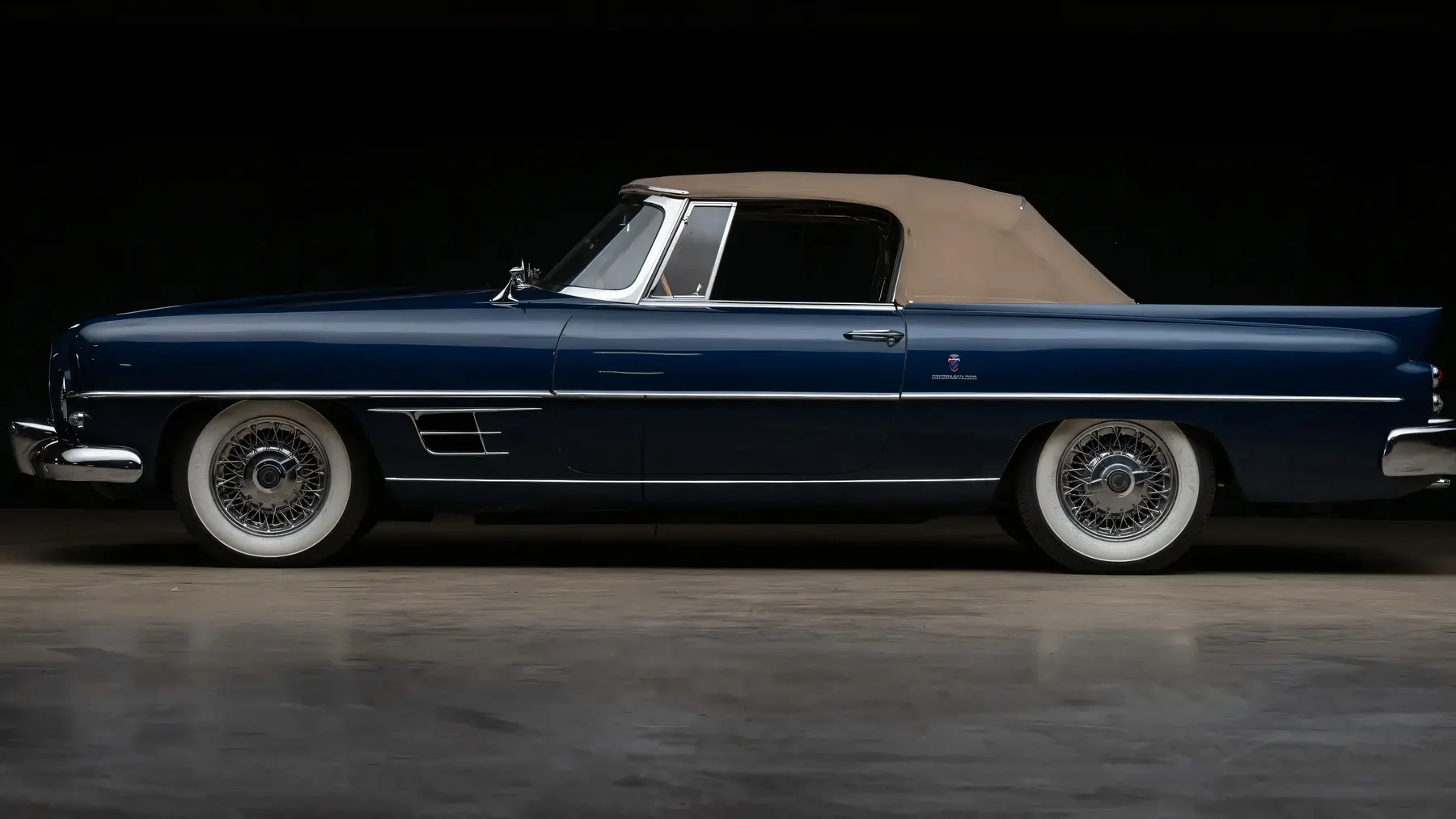
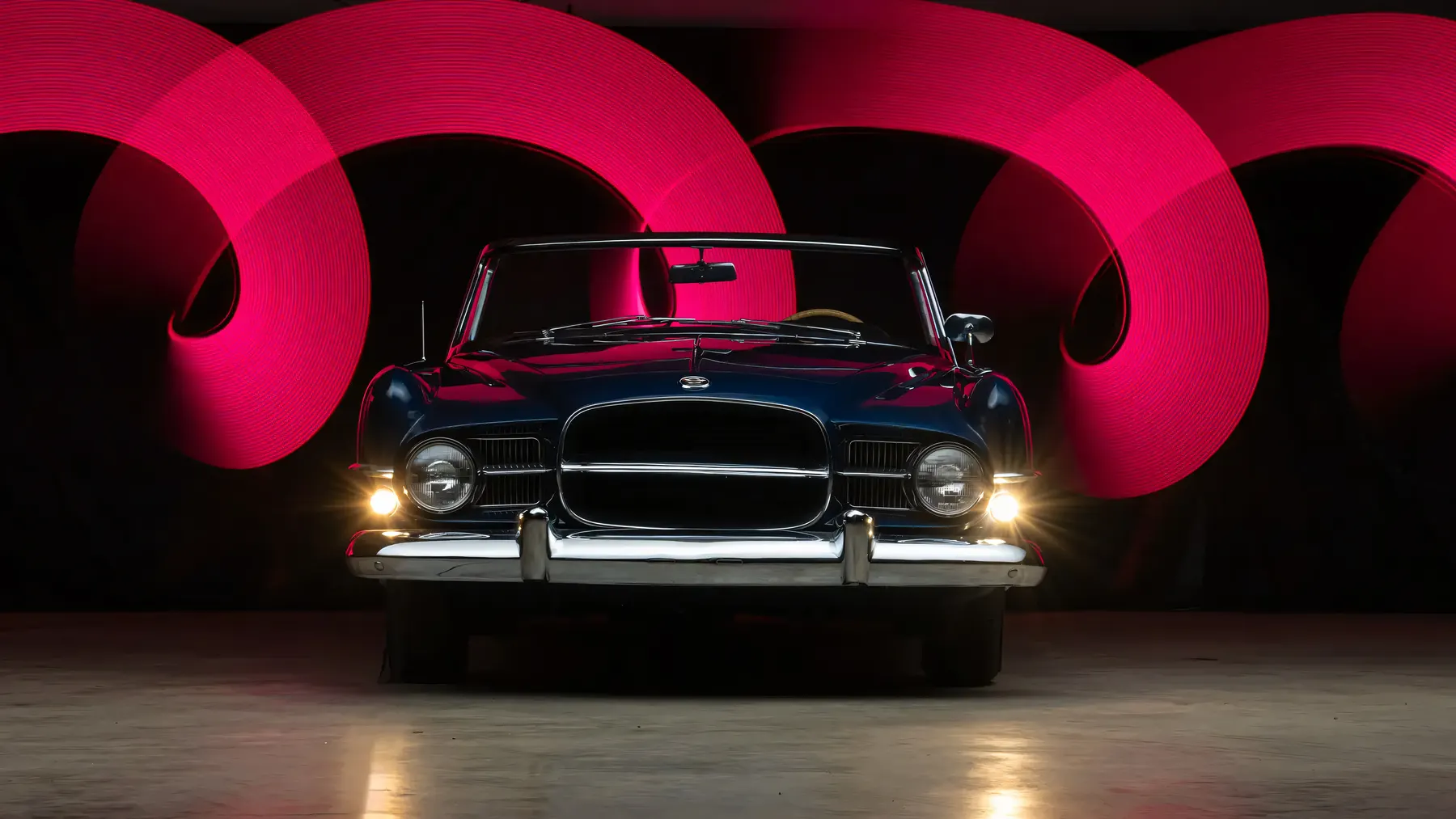
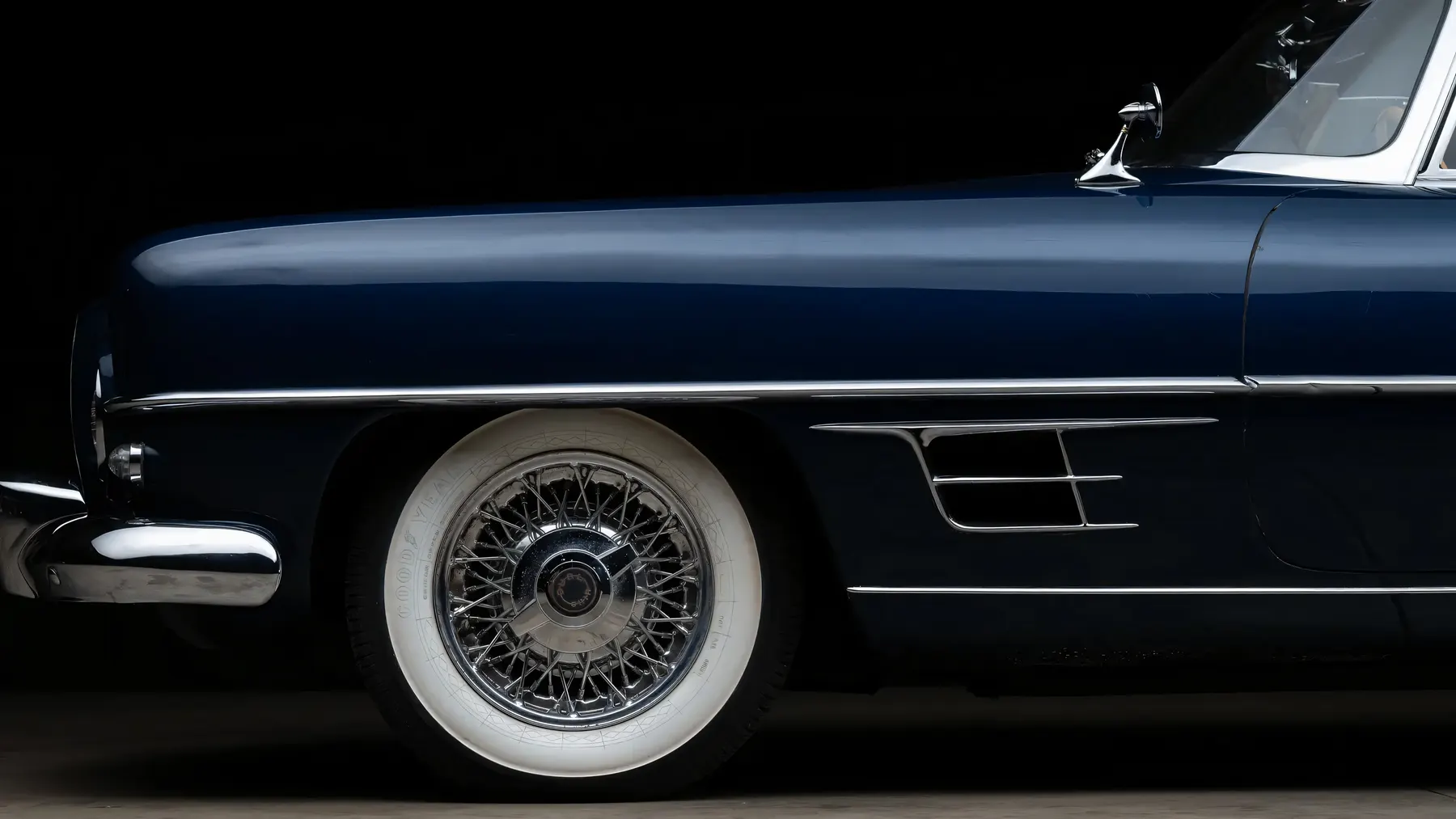
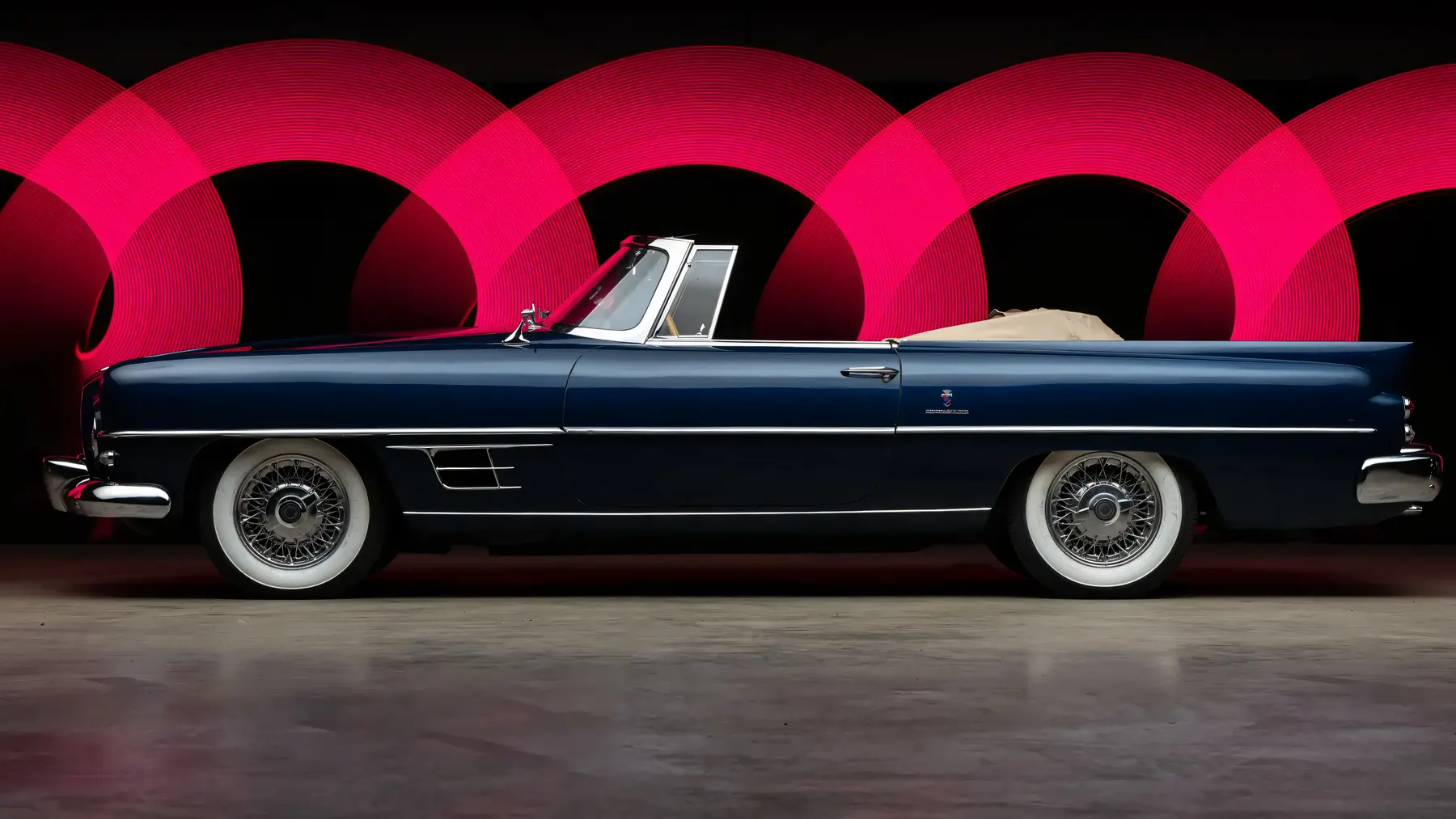
The body that emerged from this unlikely circuit was unmistakably of its moment, and yet it wore the moment exceptionally well. The proportions were long and low, anchored by a 2,921 mm wheelbase and stretched to 5,169 mm overall. Aircraft-inspired tailfins - subtle by the standards of the era’s most exuberant American designs - swept rearward with genuine authority. The front end carried a wide, open mouth inherited from the Firearrow’s Ghia lineage, flanked by stacked headlamps that gave the car a narrowed, focused expression quite unlike the wide-eyed optimism of a standard 1957 Dodge. The convertible’s soft top folded away with equal tidiness, revealing an interior that represented genuine coachbuilt luxury: hand-stitched leather, wide bucket seating, and a dashboard of a quality that Detroit’s volume manufacturers of the era simply couldn’t justify for the price.
That price was telling. At around $7,500 in period - roughly equivalent to $87,000 today - the Dual-Ghia cost marginally more than a Cadillac Eldorado Biarritz convertible. What it bought was something the Cadillac could not offer: Italian coachbuilt bodywork, hand-made and specific to you, wrapped around American mechanicals proven at the dragstrip and in the family driveway alike. The engine was a 315 cubic-inch Dodge “Red Ram” hemispherical-head V8, producing 230 bhp and mated to a Chrysler PowerFlite two-speed automatic transmission. Later D-500 models received a 5.9-litre, 361 cubic-inch version fed by dual quad carburettors, and a well-specified example could reach 120 mph - serious performance for a luxury convertible in 1957. The running gear was entirely orthodox: independent front suspension via unequal-length A-arms and coil springs, a live rear axle on semi-elliptic leaf springs, four-wheel hydraulic drum brakes. Casaroll was never trying to reinvent the wheel; he was trying to dress it better than anyone else.
The suspension of disbelief required to make the car work extended to the customer list, which reads less like a sales ledger and more like an invitation to a particular kind of party. Frank Sinatra bought at least one - possibly gifted to Ava Gardner - and owned several across the car’s brief production life. Dean Martin had one, as did Peter Lawford, Glenn Ford, Lucille Ball and Desi Arnaz (who reportedly ran a his-and-hers arrangement), Ronald Reagan before he entered the White House, Debbie Reynolds, and Richard Nixon. Casaroll was said to have hand-picked his customers, which made ownership less a commercial transaction than an act of editorial curation. The Dual-Ghia didn’t just attract celebrities; it selected them.
This social dimension was always part of its appeal, and it sits slightly uncomfortably alongside any attempt to assess the car on purely engineering terms. The Hemi V8 was not exotic - it powered Dodges that taxi companies bought - and the PowerFlite automatic was a two-speed unit that even Chrysler considered old-fashioned by 1958. The drum brakes, adequate for 120 mph in the late Fifties, represent the period’s universal concession to budget over capability. There is an argument, mounted occasionally by purists, that the Dual-Ghia was a beautifully clothed American family car with a celebrity waiting list, not a ground-breaking sporting machine. The argument has merit - and it misses the point. What Casaroll and Ghia created was not a technical landmark; it was a cultural one. They understood, years before the concept had a name, that exclusivity and handcraft could command a premium in a mass-production market, and that the place where American torque met Italian tailoring was commercially fertile ground. The Jensen Interceptor and the Iso Rivolta and the Facel Vega HK500 were all, in different ways, answering the same question.
The car’s weaknesses became structural. The economics of shipping bodyshells across the Atlantic twice, with all the hand labour Ghia’s involvement entailed, made the Dual-Ghia nearly impossible to produce at a profit. Casaroll had aimed for a production run of 150 examples; 117 were ultimately built before the model was wound up in 1958. The enterprise never scaled, and perhaps it was never meant to. What it produced instead was scarcity, which time has converted into myth: of those 117 cars, perhaps 34 convertibles survive in restorable condition. One, the Frank Sinatra-Ava Gardner example, was later preserved at the Petersen Automotive Museum in Los Angeles and featured in the 1992 television biography Sinatra.
Casaroll didn’t abandon the formula after 1958 - the subsequent Ghia L 6.4 coupe of 1961, again built with Ghia and drawing many of the same Hollywood buyers, extended the collaboration - but the convertible remained the emotional apex of the partnership, the car that most completely fused the latitude of Italian coachbuilding with the directness of American power. Critical reception in period was warm without being analytical: the car was universally acknowledged as beautiful and well-engineered, while the celebrity provenance meant that most road tests read less like technical appraisals and more like social diaries. Modern reassessments have been kinder to the engineering than contemporary reviews, recognising that the Hemi V8 in this body was a combination of genuine competence, and that the Ghia bodywork - 15 coats of lacquer, every panel hand-formed - represented craftsmanship that Detroit couldn’t source domestically at any price.
What the Dual-Ghia Convertible ultimately demonstrates is that the most enduring cars are sometimes built not by engineers pursuing a mechanical ideal but by entrepreneurs pursuing an aesthetic one. Casaroll looked at the Dodge Firearrow, at the question the crowds kept asking at auto shows, and answered it with a transatlantic production chain, a hand-picked clientele, and a car that looked, inside and out, like nothing Detroit made. The result was 117 cars, a celebrity register that reads like a Golden Age roll call, and a handful of survivors that continue to command six-figure sums at auction - the only tangible evidence that one man’s passion project briefly occupied the precise intersection of Detroit muscle and Via Roma elegance, and then disappeared before anyone could quite believe it had happened.