1957 Facel Vega FV2B Cabriolet
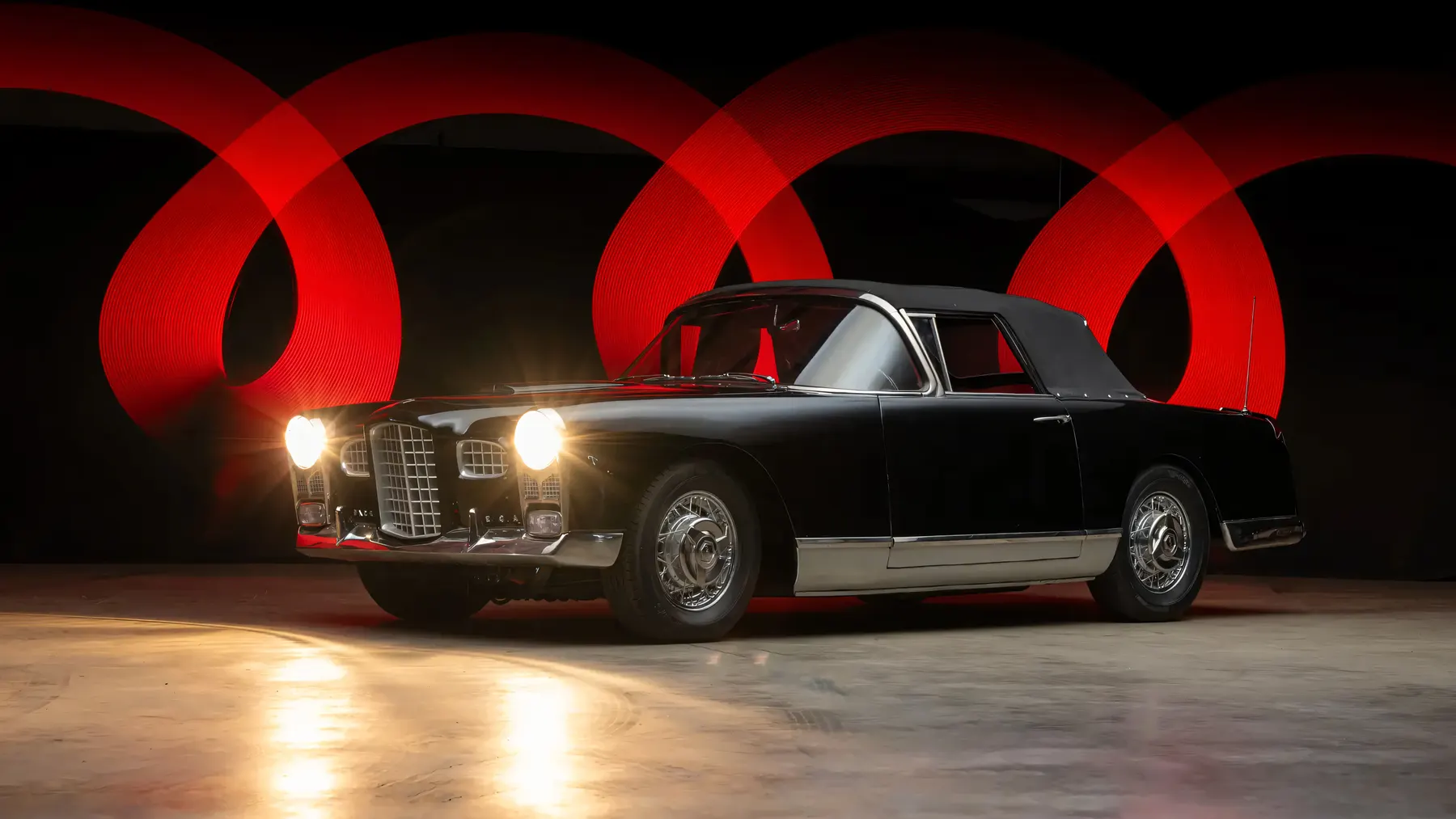
The Facel Vega FV2B Cabriolet occupies a position so rare in automotive history that calling it simply a “convertible variant” feels almost reckless. Among the 72 FV2B examples built across its brief production window - April 1956 to late 1956 - just two were completed as cabriolets, making this one of perhaps the most thinly spread open-top body styles ever to emerge from a serious manufacturer. It is not a special edition or a show car; it is what happens when a small, artisanal French atelier with coachbuilding DNA simply builds what a customer wants, and does so with total conviction.
Jean Daninos founded Facel - Forges et Ateliers de Construction d’Eure et Loir - as a metalworking concern that produced aircraft components and bodywork for other manufacturers before deciding, in 1954, to build a complete car of its own. The logic was pragmatic but audacious: rather than develop every component from scratch, Daninos would source the engine from America, clothe it in hand-finished French coachwork of the highest order, and sell the result to exactly the sort of clientele who bought Bentley Continentals and thought nothing of the cost. The FV series was that car, and the FV2B was its most muscular early expression.
The “B” suffix in FV2B signified a critical mechanical step forward. In 1956, Facel swapped out the earlier DeSoto-sourced unit for a larger 5.4-litre Chrysler V8 - in the cabriolet’s case, a 354-cubic-inch Chrysler “Hemi” - producing 340 bhp at 5,200 rpm through dual Carter four-barrel carburettors. The electrical system was simultaneously upgraded to 12-volt, and power steering was offered as a standalone option on just 20 of the 72 FV2Bs built. The Chrysler PowerFlite two-speed automatic with its push-button selector column sat alongside the optional four-speed Pont-à-Mousson manual gearbox, the latter a locally built unit with synchromesh on all forward gears. The chassis itself was a bespoke tubular steel frame with wishbones and coil springs up front and a live rear axle on semi-elliptic leaf springs - not sophisticated, but robust and well-suited to the car’s grand touring mission.
What made the FV series genuinely distinctive was Daninos’s stubborn insistence on using stainless steel for exterior trim rather than chrome - a subtler, more durable choice that gave the bodywork a cleaner resolve than its American-influenced contemporaries. The wraparound panoramic windshield, introduced with the FV2 and carried into the FV2B, was borrowed architecturally from Detroit but executed with Parisian finesse. On the cabriolet, that screen stood as the car’s most visually dramatic feature, curving into a body that was already wide and assertive. Inside, leather was used without compromise - covering surfaces that would never be seen, not as a selling point but simply because that was how Daninos understood quality. The dashboard, rendered in trompe-l’œil metalwork hand-painted to resemble burled wood by Marcel Bigot, the head of Facel’s paint department, was among the more extraordinary details in any luxury car of the era.
The driving experience leaned heavily on the torque of the Hemi rather than any pretense of athletic agility. The rear live axle limited cornering precision in a way that any contemporary Jaguar would have exploited - but Facel was not selling corner-carvers. It was selling the sensation of crossing France at illegal speed in absolute comfort, with a V8 soundtrack that no European rival could manufacture. For the cabriolet buyer, roof-down motoring at that pace was a particular kind of theatre: the wraparound screen deflecting enough wind to make high-speed open-air travel liveable, the Hemi growling contentedly, the stainless trim catching whatever light the road offered.
The weaknesses were real and not trivial. The drum brakes - 11-inch finned items, which were generous by 1956 standards - were nonetheless working hard to arrest over a thousand kilograms of American-engined French luxury from the velocities the Hemi encouraged. The reliance on Chrysler running gear was a commercial vulnerability too; Facel’s customers were paying Bentley money for a car that, under the bonnet, owed its soul to Highland Park, Michigan. In France, this was a point of some sensitivity, and it never entirely left the car’s critical reputation.
Across the entire FV model line - encompassing seven variants and 354 total cars built between 1954 and 1958 - only approximately 11 cabriolets were ever made, of which perhaps five are known to survive today. The FV2B accounts for just two of those open examples, which means the cabriolet was never a volume proposition; it was a bespoke interpretation of an already bespoke machine. The FV series was ultimately replaced by the HK500 in 1958, which continued refining the formula with bigger Chrysler engines before Facel’s eventual collapse in 1964, but the FV2B Cabriolet represents the model line at its most uninhibited - the point where the factory’s coachbuilding past and its grand touring present occupied the same body simultaneously.
At the RM Sotheby’s Monterey sale in August 2024, one of the two surviving FV2B cabriolets realised $235,200 - a figure that reflects both the car’s extreme rarity and the growing collector recognition of Facel’s singular place in postwar European luxury. When the wider market has been busy reassessing Franco-American hybrids on their artistic and engineering merit rather than their national purity, the FV2B Cabriolet - two made, possibly five of its bloodline left on earth - keeps looking like one of the most undervalued stories in the whole of the 1950s.