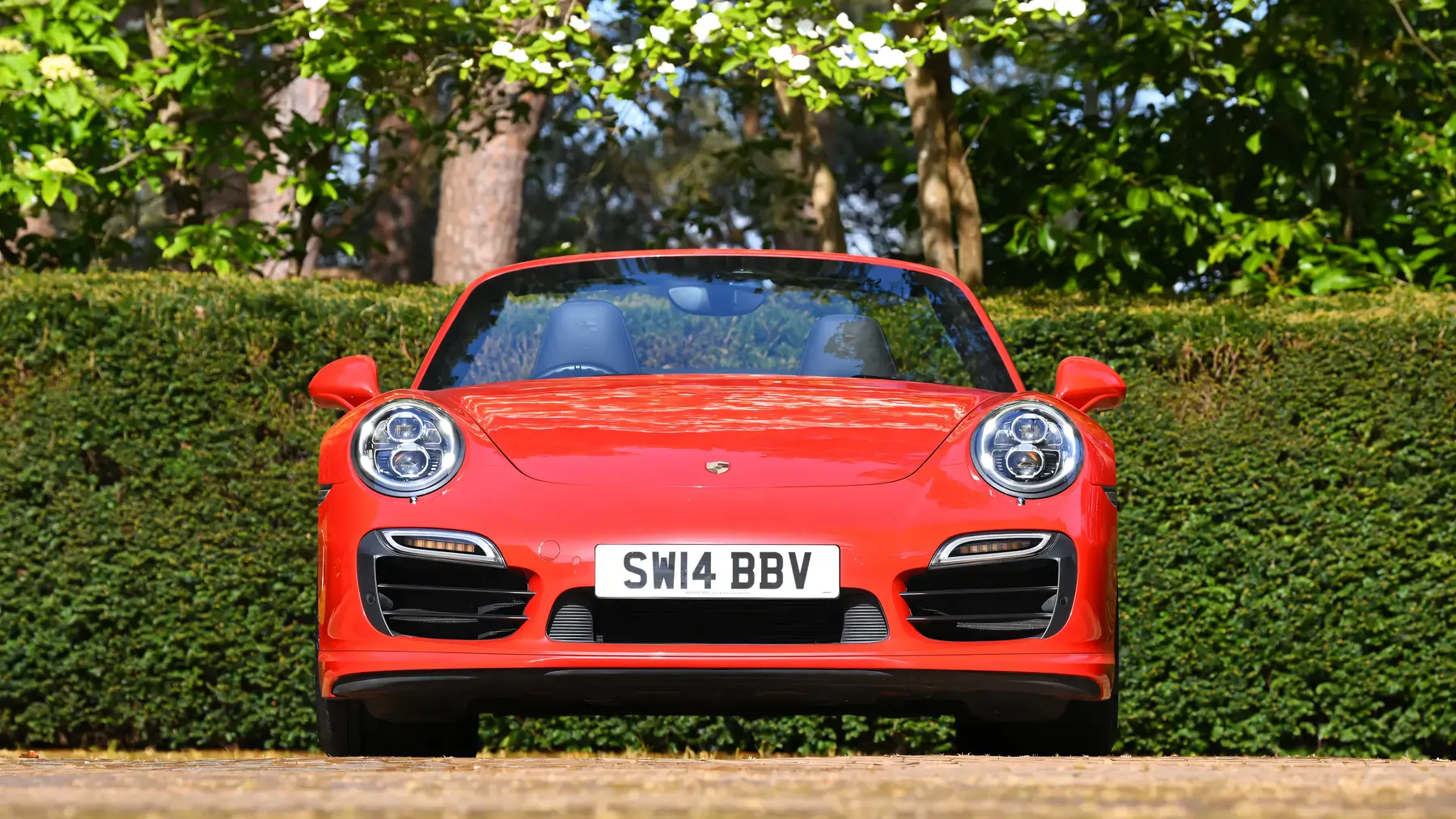
2014 Porsche 911 Turbo S Cabriolet
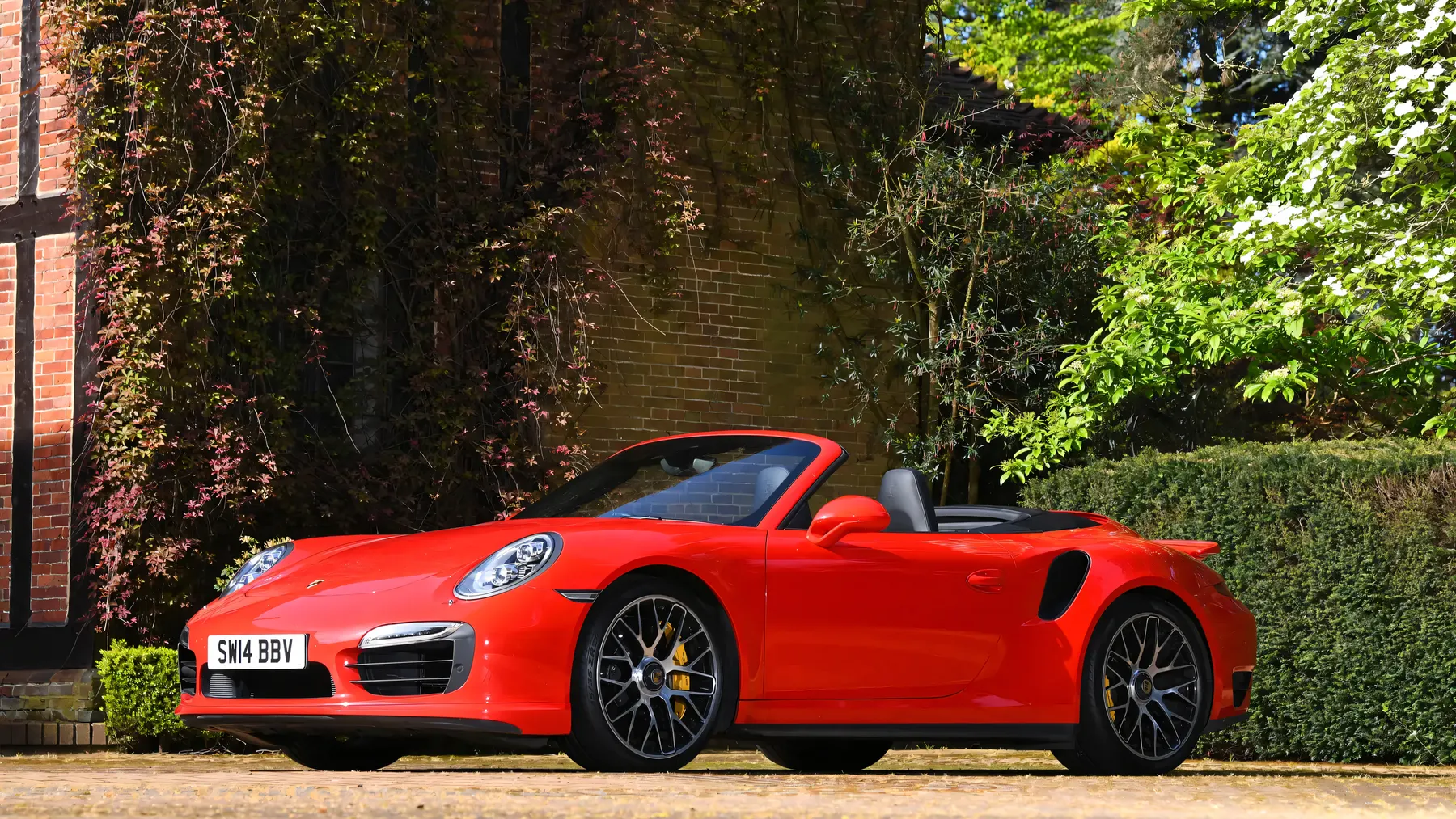
There is a peculiar kind of automotive confidence that only Porsche seems capable of projecting - a quiet certainty that the car you are buying today is the product of more than five decades of unbroken engineering conviction. The 911 has always traded on that certainty, and nowhere does it feel more consolidated, more fully realised in a single model, than in the 991.1 Turbo S Cabriolet. This is a car that answers a question nobody quite knew how to ask: what happens when you take the most technically accomplished open-top sports car in production and strip away the roof of its already borderline-absurd performance variant? The answer, it turns out, is extraordinary.
The 991 itself arrived at the 2011 Frankfurt Motor Show as something of a quiet revolution. Only the third entirely new platform since the 911’s introduction in 1963 - the 996 of 1999 was the second - it brought a 100mm increase in wheelbase to 2,450mm, a 70mm stretch in overall length, and a structural rethink that moved the rear wheels 76mm further back relative to the engine, meaningfully improving weight distribution. High-strength steel, aluminium, and composite materials were deployed throughout the body structure, and the result was a car that felt measurably more mature than the 997 it replaced - larger, yes, slightly heavier in some configurations, but possessed of a composure that no predecessor had quite matched. By the time sales figures were strong in 2013, Porsche introduced the model that would define the generation for anyone with genuinely extravagant intentions: the Turbo S Cabriolet, arriving in September of that year.
What made the 991.1 Turbo S particularly significant was the manner in which Porsche chose to deploy it. In every previous generation of the 911, the Turbo S had been a late-cycle special - a last hurrah released after the standard Turbo had already matured through several years of production. The 991 generation broke that tradition entirely; the Turbo S debuted almost simultaneously with the base Turbo, and it was equipped with technologies that would define the model’s reputation rather than merely extend it. Rear-axle steering and active aerodynamics appeared on the 991 Turbo S as standard fitment for the first time in the nameplate’s history - and they were not tokens. They were the whole point.
The hardware beneath the Turbo S Cabriolet’s haunches is, by any reasonable measure, staggering. The twin-turbocharged 3.8-litre flat-six breathes out 560 PS (552 bhp) and 700 Newton-metres of torque, a figure that swells to 750 Nm under overboost conditions. The seven-speed PDK - the only gearbox offered, and we will come to that - routes every newton-metre to all four wheels through Porsche’s electronically controlled all-wheel-drive system. The official 0–100 km/h figure is 3.1 seconds, though road testers from multiple publications recorded times of 2.6 seconds under real-world launch control conditions, and the car will continue on to a top speed of 318 km/h. In the context of 2013, when the Ferrari 458 Spider - the benchmark open-top supercar of its era - completed the same sprint in around 3.4 seconds, the Turbo S Cabriolet was not merely competitive; it was in a different category of violence.
The rear-axle steering deserves more than a footnote in any honest accounting of this car’s engineering. Below approximately 50 km/h, the rear wheels turn in the opposite direction to the fronts - effectively shortening the wheelbase by around 250mm, making the car feel markedly more nimble in tight corners than its physical dimensions would suggest possible. Above that speed, the rear wheels turn in the same direction as the fronts, virtually lengthening the wheelbase and adding a layer of stability at speeds where that 318 km/h ceiling begins to feel less theoretical. The active aerodynamics work in concert with this: a pneumatically actuated front spoiler with three independently controlled segments, calibrated continuously against speed, throttle position, and braking inputs. Under full braking at high speed, both the front spoiler and rear wing move to their maximum-drag positions simultaneously - functioning as an airbrake - without any driver input. These systems are genuine engineering achievements, not marketing copy, and they are standard on every Turbo S regardless of specification.newsroom.
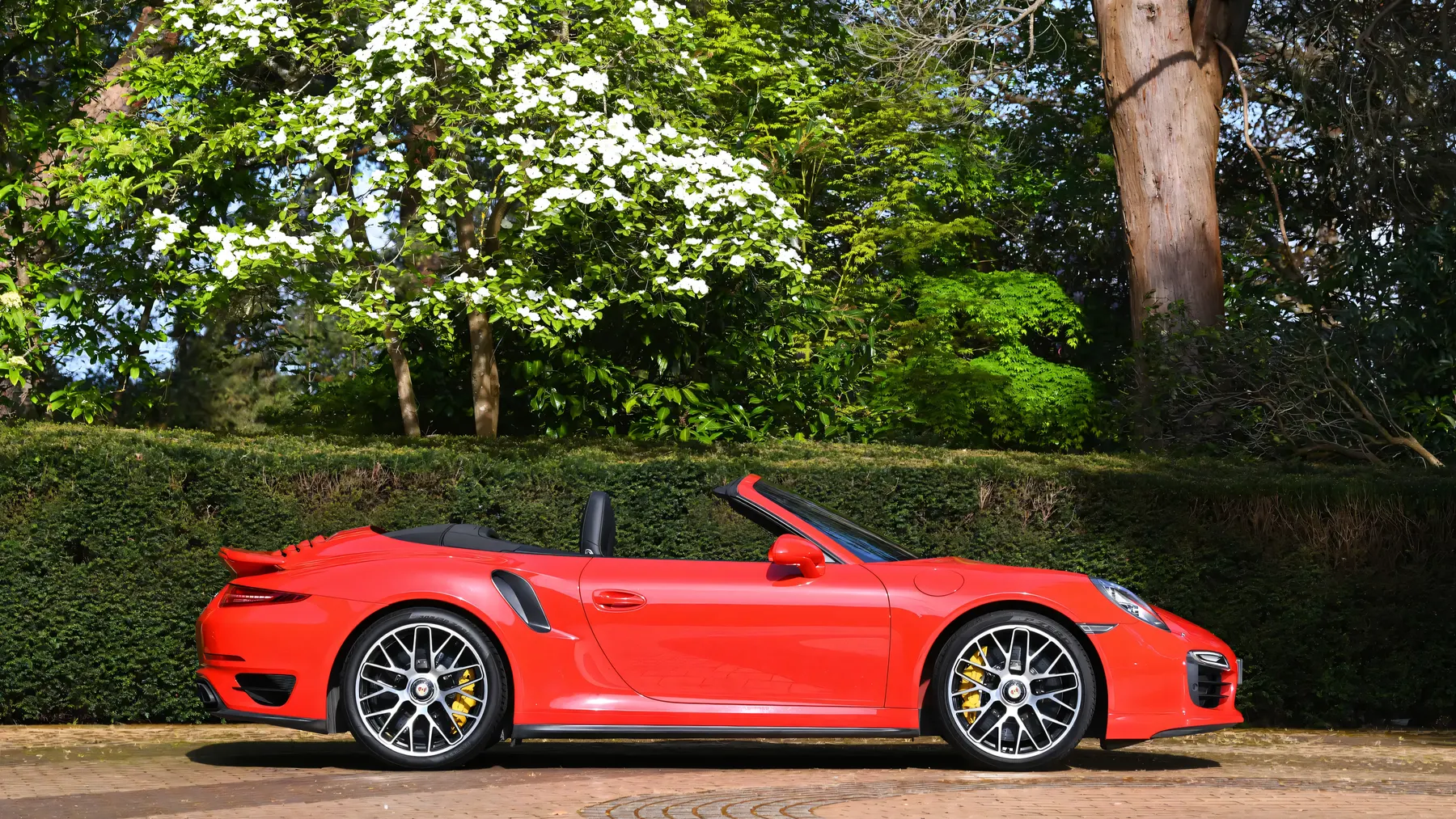
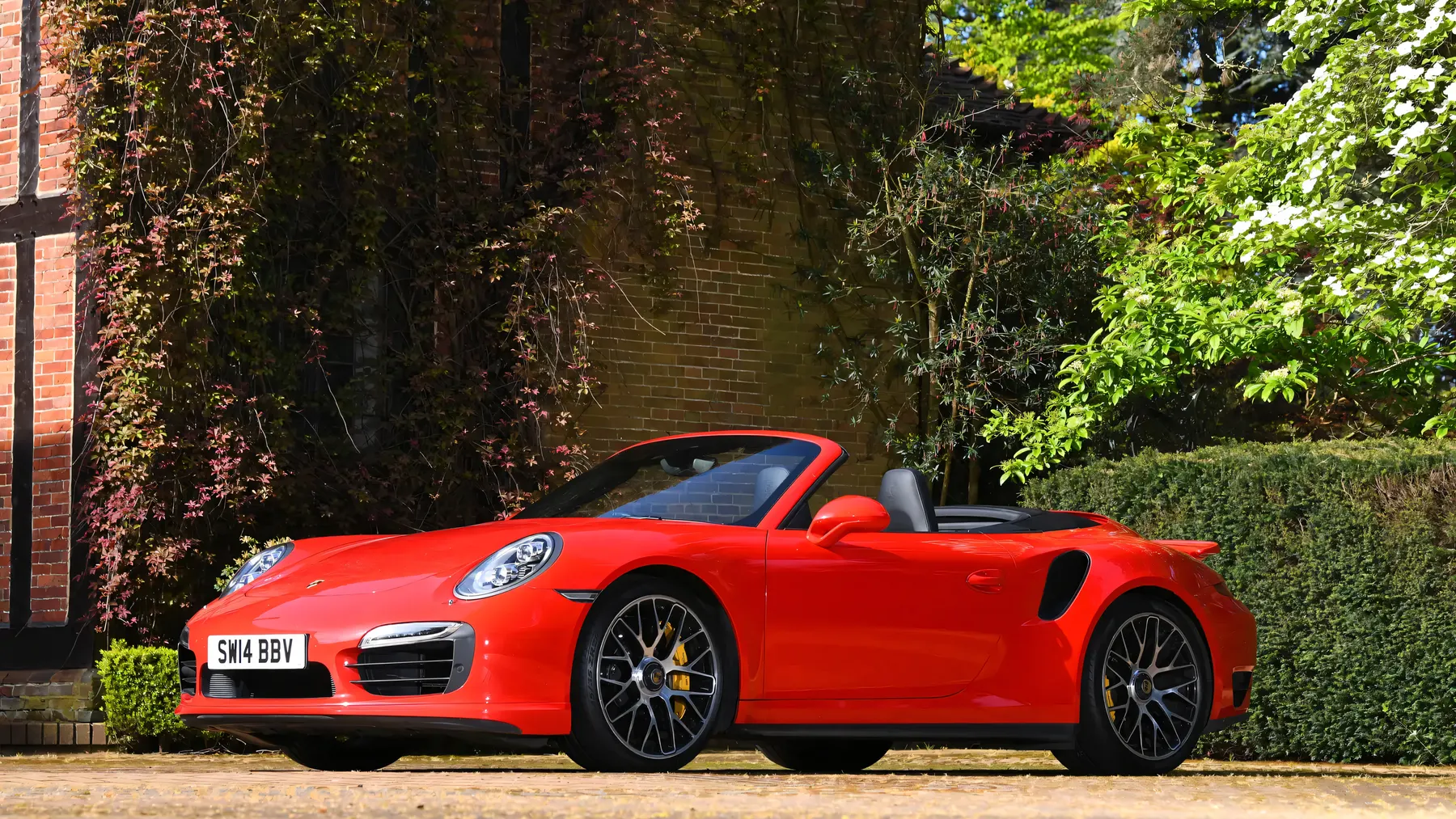
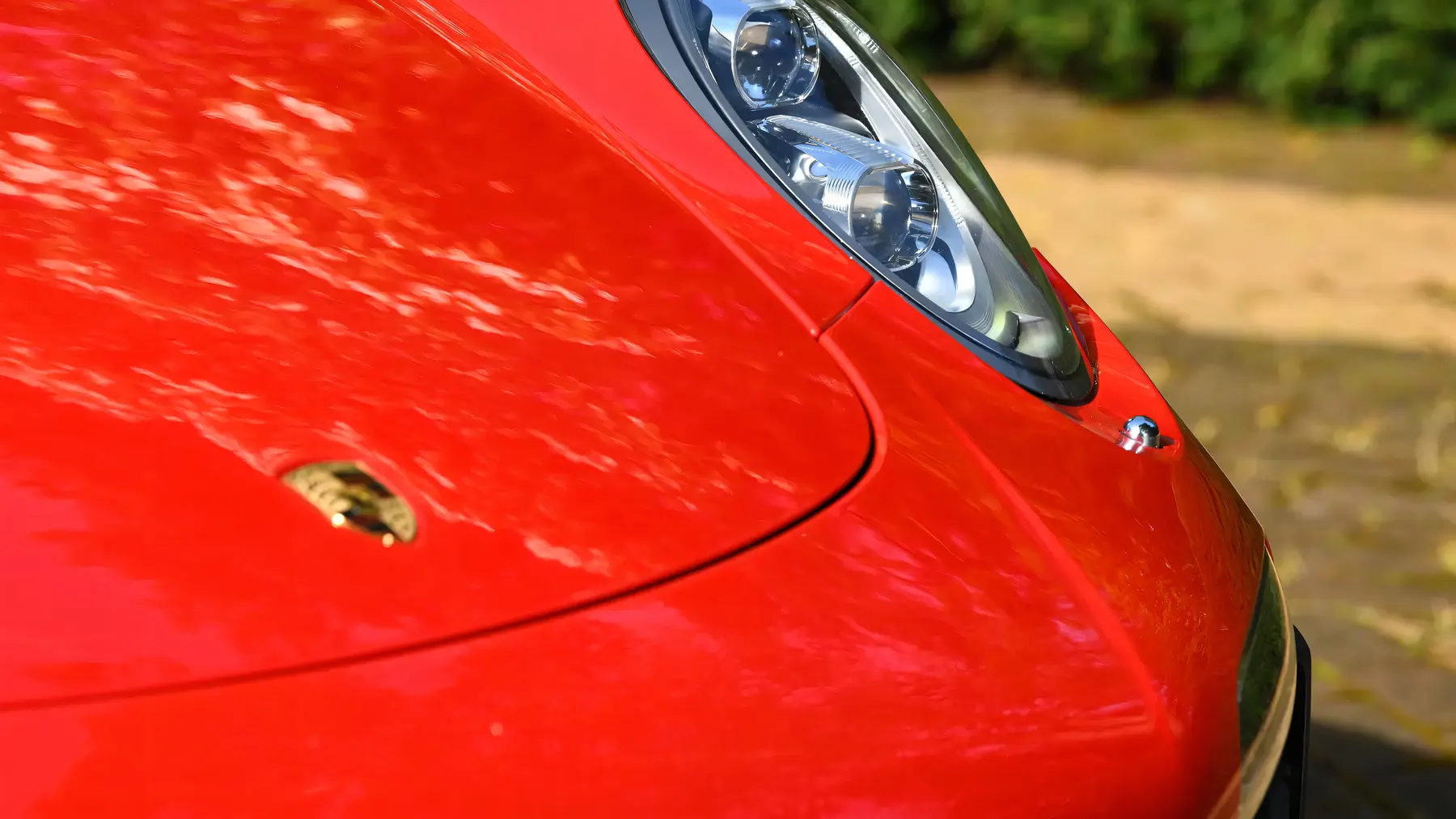
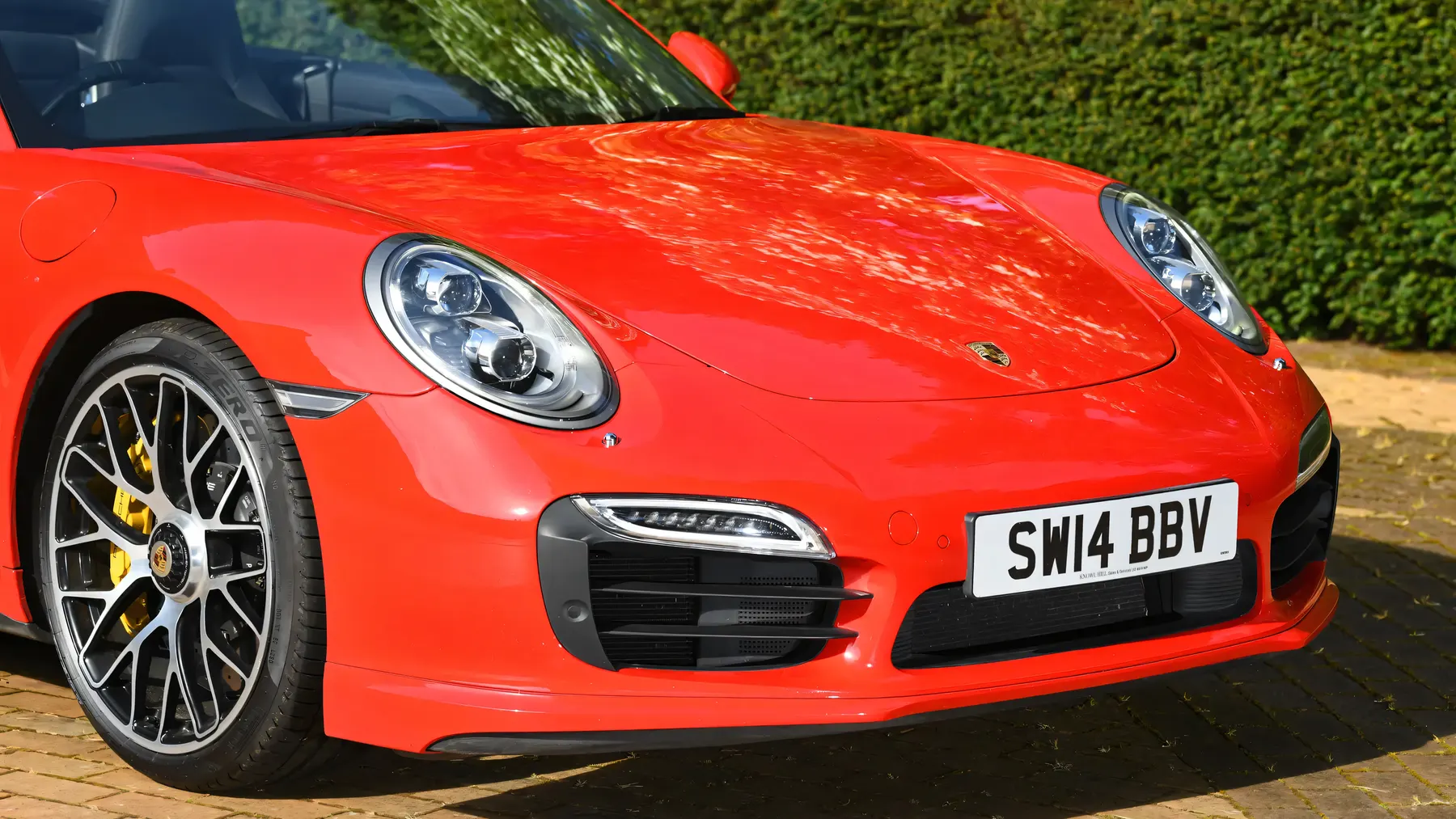
Aesthetically, the 991 Turbo S sits in an interesting tension between restraint and theatre. Porsche did not reinvent the visual grammar of the 911 with this generation - they refined it, stretching the car slightly, widening the hips, and giving the Turbo S an exclusive front fascia with integrated “Airblades” that channel cooling air through the bumper. Black-chrome-tipped exhausts and two-tone leather upholstery - standard on the Turbo S and unavailable on the base Turbo - give the car a sense of differentiation that is not achieved through vulgarity. The Cabriolet’s fabric roof, operating electrically in around thirteen seconds and able to deploy at speeds up to 50 km/h, is impressively rigid when raised - the kind of precision-engineered folding architecture that reveals itself only when you close the door and notice the absence of flex, the tomblike solidity of the body structure. Body stiffening mandated by the open configuration adds approximately 70 kilograms over the coupe, bringing the Turbo S Cabriolet to a kerb weight somewhere in the region of 1,675 kg - not a light car, but managed with sufficient engineering intelligence that it rarely feels its mass.topgear+2
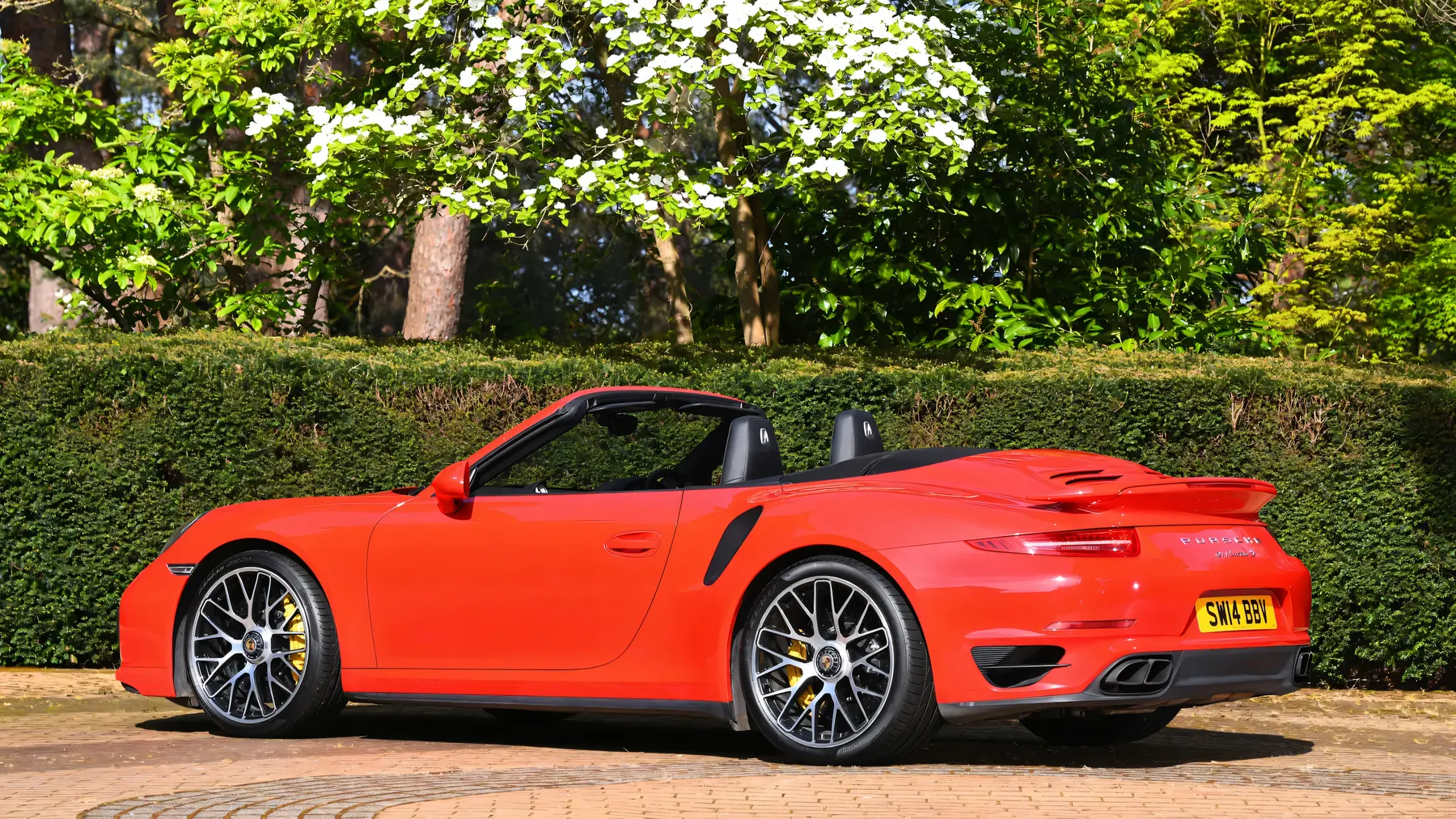
From behind the wheel, the experience confounds expectation in several directions at once. At urban speeds, the Turbo S Cabriolet is unexpectedly docile - compliant, well-mannered, perfectly content to burble through traffic with the PDK in seventh and the revs barely registering. The ride is firm rather than brutal, with the kind of underlying compliance that speaks to genuine chassis tuning rather than simply large tyre sections absorbing irregularities. Then, somewhere above 3,000 rpm, the turbos wake up, and the experience changes entirely. Top Gear’s first UK test captured the sensation precisely: “third gear unleashes volcanic performance, and the sensation as you pass the 2,800rpm boost threshold and ride out the acceleration to the 7,000rpm red line is the sort of thing someone would make a fortune out of if they could bottle it.” The roof-down configuration adds a sonic dimension that the coupe cannot replicate - the turbos’ intake and exhaust notes becoming audible and immediate, creating what one tester described as “a sonic brew that alters in real time depending on what you’re doing with your right foot.” The limits of grip and stability are simply beyond what public roads can test in any meaningful sense.
Among the Turbo S Cabriolet’s most quietly impressive qualities is the way Porsche’s ceramic composite brake system - the PCCB, fitted as an option and identifiable by its yellow callipers, a colour inherited directly from the 964 Turbo S that first introduced the system in 1992 - transforms high-speed deceleration from a mechanical event into something approaching a philosophical one. The retardation is immediate and enormous, but the feel through the pedal is precise enough that the car never becomes intimidating in its stopping ability. Combined with the all-weather capability of the AWD system and the rear-axle steering’s contribution to stability, this is a car whose real-world envelope of competence extends far beyond what most sports cars of any price can offer.
It would be dishonest, however, to wave away the reservations. The PDK-only configuration - Porsche removed the manual option entirely with the 991 Turbo generation - drew criticism in 2013 and continues to divide opinion. The counter-argument is well-established and largely compelling: the PDK suits the car’s character better than any manual could at this performance level, and the shift times it achieves are beyond human capability. But the removal of choice carries a philosophical cost, and for a certain kind of driver, the absence of a third pedal represents a genuine reduction in involvement, regardless of the objective performance penalty. Road and wind noise at motorway speed is also more present than the car’s overall level of refinement might lead you to expect - a surprise given how thoroughly engineered everything else feels, and an area where the Turbo S falls short of true grand touring pretensions. The interior technology of the 991.1, while entirely functional, ages less gracefully than the chassis beneath it; the PCM infotainment system, already slightly behind the curve at launch, now carries the weight of more than a decade. And while the Turbo S is deeply capable, some critics note that its competence has a quality of aloofness - a willingness to dismiss corners and climatic conditions with such authority that a more communicative, more rawly involving car can occasionally seem preferable to those who value sensation over security. The cultural footprint of the 991.1 Turbo S is framed by its lineage. The 911 Turbo as a concept was born in 1975 with the 930 - a car so overpowered relative to the tyres and chassis of its era that it earned the nickname “widowmaker.” The evolution from that car to the 991.1 Turbo S is a story not just of power increases but of technology progressively closing the gap between the car’s potential and the driver’s ability to exploit it safely. The rear-axle steering, the active aerodynamics, the electronic AWD, the PDK - every system is a tool designed to make an implausible amount of performance accessible without demanding mastery. The 991 generation as a whole concluded in December 2019 with 233,540 examples produced across all variants, and the Porsche 911 reached its one-millionth example in May 2017. The 911 had placed fifth in the 1999 Car of the Century poll - one of only two cars in the top five that had never left production - and the 991 generation did nothing to diminish that stature.
Press reception of the 991.1 Turbo S Cabriolet was almost uniformly reverential, with criticism reserved largely for the points already noted. Auto Express called it “a serious performance car, with the kind of acceleration and handling that could embarrass supercars with much higher price tags.” The Australian market’s assessment from Carsales was perhaps the most perceptive: that what makes the Turbo S an engineering marvel is not its raw numbers but its “ruthlessly effective ability to make mere mortals feel superhuman behind the wheel.” Top Gear went further, arguing that the Cabriolet - not the coupe - was the Turbo to have, precisely because “in a car that delivers an overwhelming sensory overload, the rush of air over your head adds yet another dimension.” Occasionally a note of reservation crept in: the sense that other cars are more nuanced, will convey more detail about the road and weigh less, if that is your bag. It is a fair point. The 991.1 Turbo S Cabriolet is not the most communicative car at this price, nor the lightest, nor the most theatrical at low speeds.
What it is, without serious challenge, is one of the most comprehensively resolved open-top performance cars ever built to that point in history - a machine that carries fifty years of engineering accumulation with remarkable elegance, that can whisper through morning traffic and then, three minutes later, render the horizon a temporary irrelevance. The fact that Porsche managed to achieve this in a drop-top configuration, without structural compromise or dynamic regression, speaks to the particular genius of the 991 platform. It is not a perfect car - nothing interesting ever is - but in the space between its documented numbers and its lived experience, the 991.1 Turbo S Cabriolet does something that very few performance machines manage: it consistently exceeds what the specifications lead you to expect, and then, roof down, it makes the whole improbable exercise feel like the most natural thing in the world.
Related Notes
- The 1980s Supercar era
- Grand Touring - The Concept and Its Origins
- Modern Materials Carbon Fiber and Aluminum
- Dunlop Disc Brakes and the End of the Drum Era
- 1959 Borgward Isabella Coupé
- 1989 Aston Martin V8 Vantage Volante ‘X-Pack’
- 1998 Aston Martin V8 LWB Volante
- Radial-Ply Tyres and the Revolution in Road Handling
- Postwar German Mid-Market Cars - Opel, Ford, and the Gap Borgward Filled