1989 Aston Martin V8 Vantage Volante 'X-Pack'
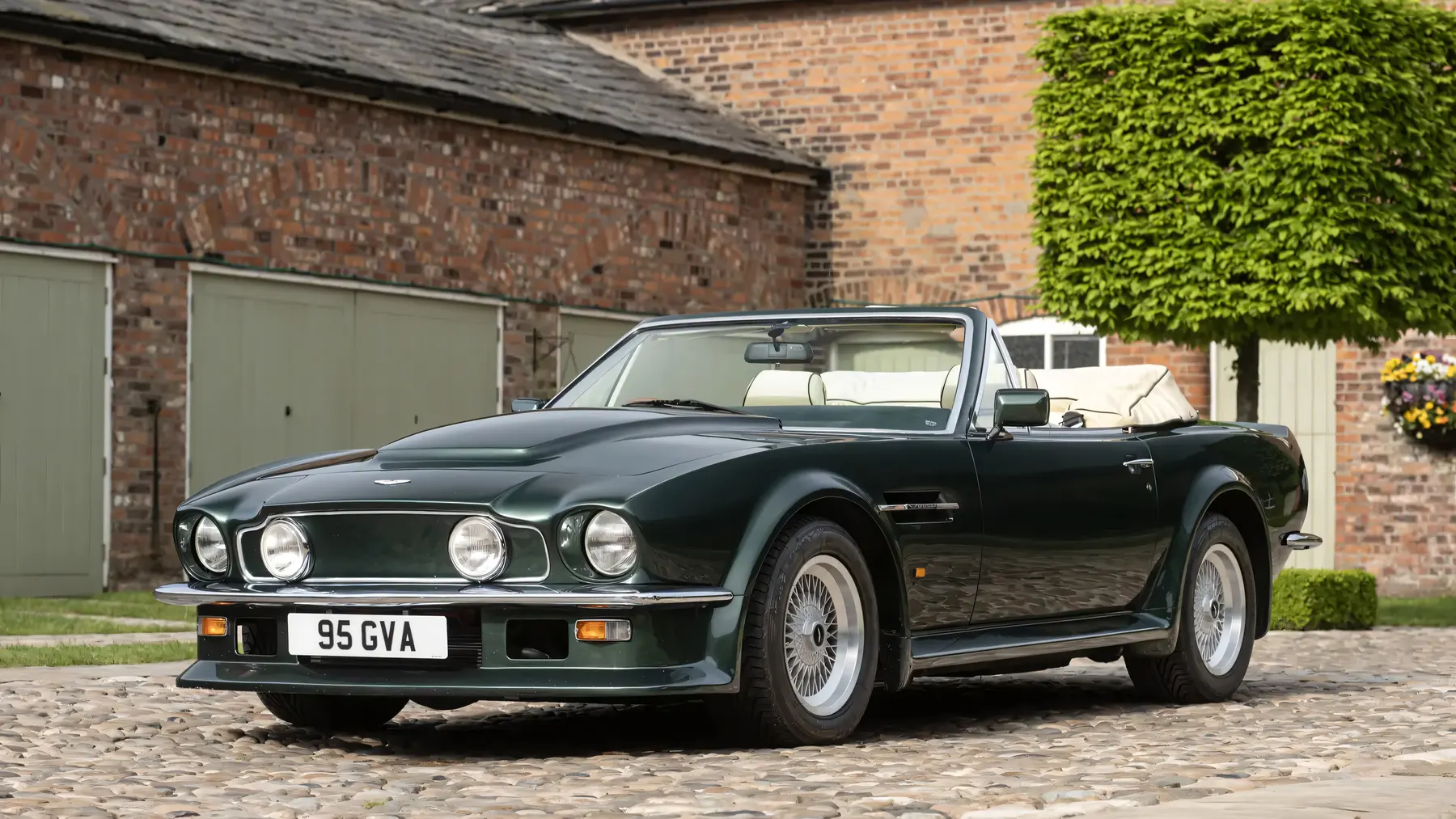
Four hundred and ten brake horsepower, in 1989, from a naturally aspirated engine that first saw light in a gentleman’s road car. Pause on that number for a moment, because the engineers at Newport Pagnell arrived at it without turbochargers, without superchargers, without any of the chemical shortcuts their Italian rivals were beginning to reach for. They did it the hard way — deeper breaths through four mammoth 48 mm Weber carburettors, Cosworth-forged pistons, larger inlet ports, and high-lift camshafts wringing the last honest horsepower out of a block that Tadek Marek had first sketched in 1963. The result was the V580X — unofficially the X-Pack — and in its Volante guise, it represented something genuinely rare: a supercar that could embarrass the opposition with its hood down.
The story of how the X-Pack came to exist is inseparable from the broader narrative of the Aston Martin V8, a car that had been carrying Newport Pagnell’s performance ambitions since 1969 and the V8 Vantage specifically since 1977. That original Vantage had earned itself a remarkable accolade — Britain’s first genuine supercar, with a 170 mph top speed that left rivals from Ferrari and Lamborghini looking over their shoulders. But twelve years is a long time in automotive development, and by the mid-1980s the landscape had shifted dramatically around Newport Pagnell’s handbuilt heavyweight. The Italians had been busy. Porsche’s 911 Turbo was maturing into something formidably competent. Aston’s answer, characteristically, was not a clean-sheet redesign — they simply turned the existing engine up further than anyone had thought sensible.
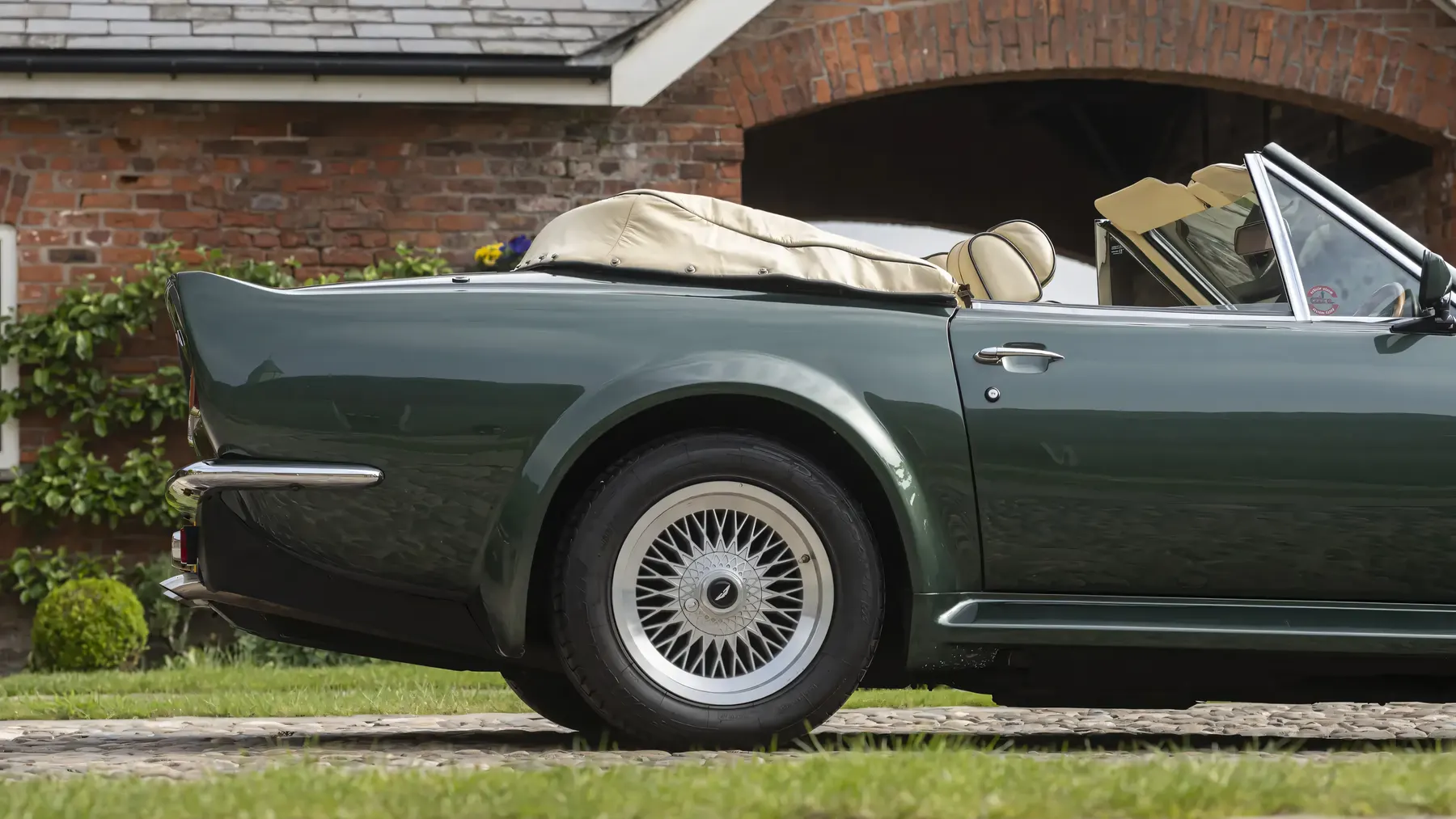
The X-Pack designation arrived officially at the 1986 Birmingham Motor Show, and it marked the beginning of the final three-year chapter for the V8 Vantage nameplate, closing a production run that had stretched across an extraordinary twelve years. The AMOC formally refers to these cars as Series 3, though they’re equally well known as V580X — the prefix stamped into the engine number that distinguishes them from lesser Vantages. Aston built just 167 Vantage Volantes across the model’s entire run, and of those, only 79 were delivered with the ZF five-speed manual transmission fitted from the factory rather than the optional Chrysler Torqueflite three-speed automatic. Rarity, then, was baked in from the start. The Volante — Aston’s traditional designation for their open-top variants — already represented the most indulgent interpretation of the Vantage formula, and pairing it with the X-Pack engine turned it into something approaching a contradiction in terms: a convertible grand tourer with genuine supercar performance credentials.
At the heart of the matter is Marek’s V8, displaced to 5.3 litres and breathing through those four enormous Webers — each one 48 mm in bore, feeding the engine with a directness that the fuel injection system from the contemporary Lagonda was simply not trusted to match at these power levels. The decision to stick with carburettors was pragmatic rather than romantic; Aston’s engineers correctly judged that the Lagonda’s injection setup lacked both the reliability and the outright flow capacity the X-Pack specification demanded. Peak output lands between 410 and 420 bhp at 6,000 rpm, with maximum torque of 395 lb-ft arriving at 5,100 rpm — figures that translate into a 0-60 mph time of 5.2 seconds and a flat-out capability exceeding 160 mph. For those who wanted still more, Works Service offered a big-bore conversion: 50 mm chokes, straight-through exhausts and a meticulously reworked airbox that unlocked 432 bhp — the same specification as the limited-production V8 Zagato, from which the X-Pack’s development drew heavily.
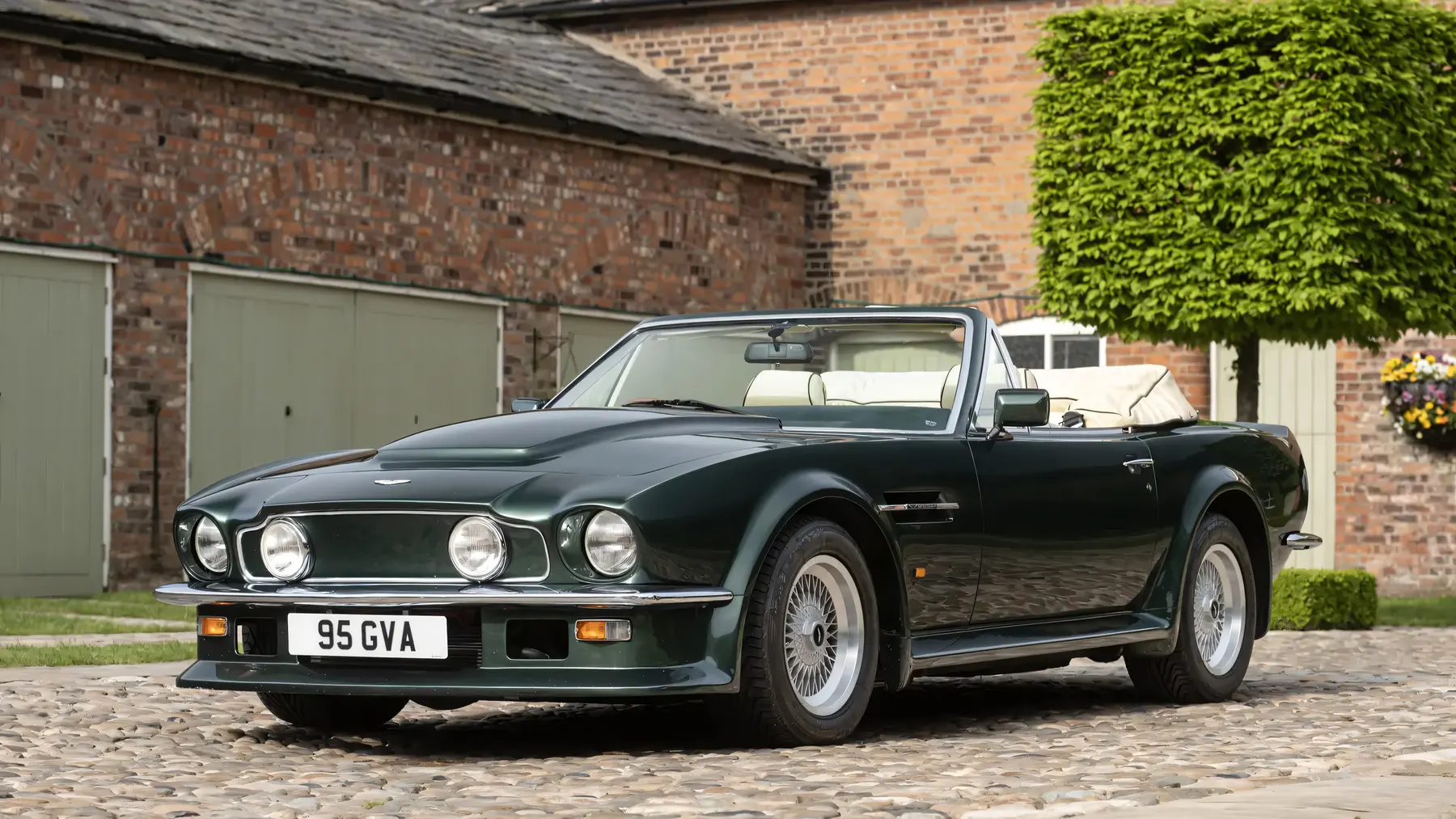
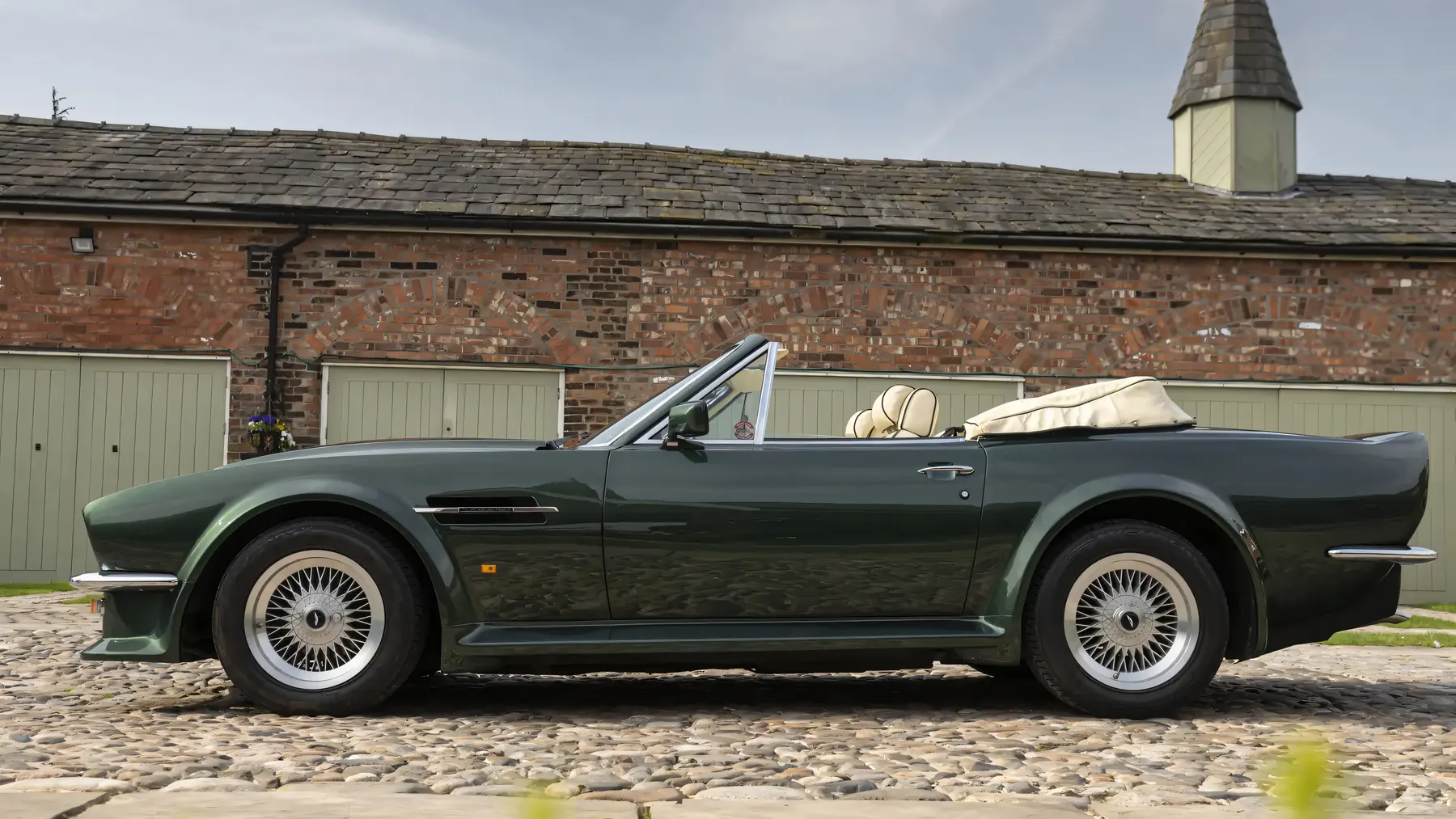
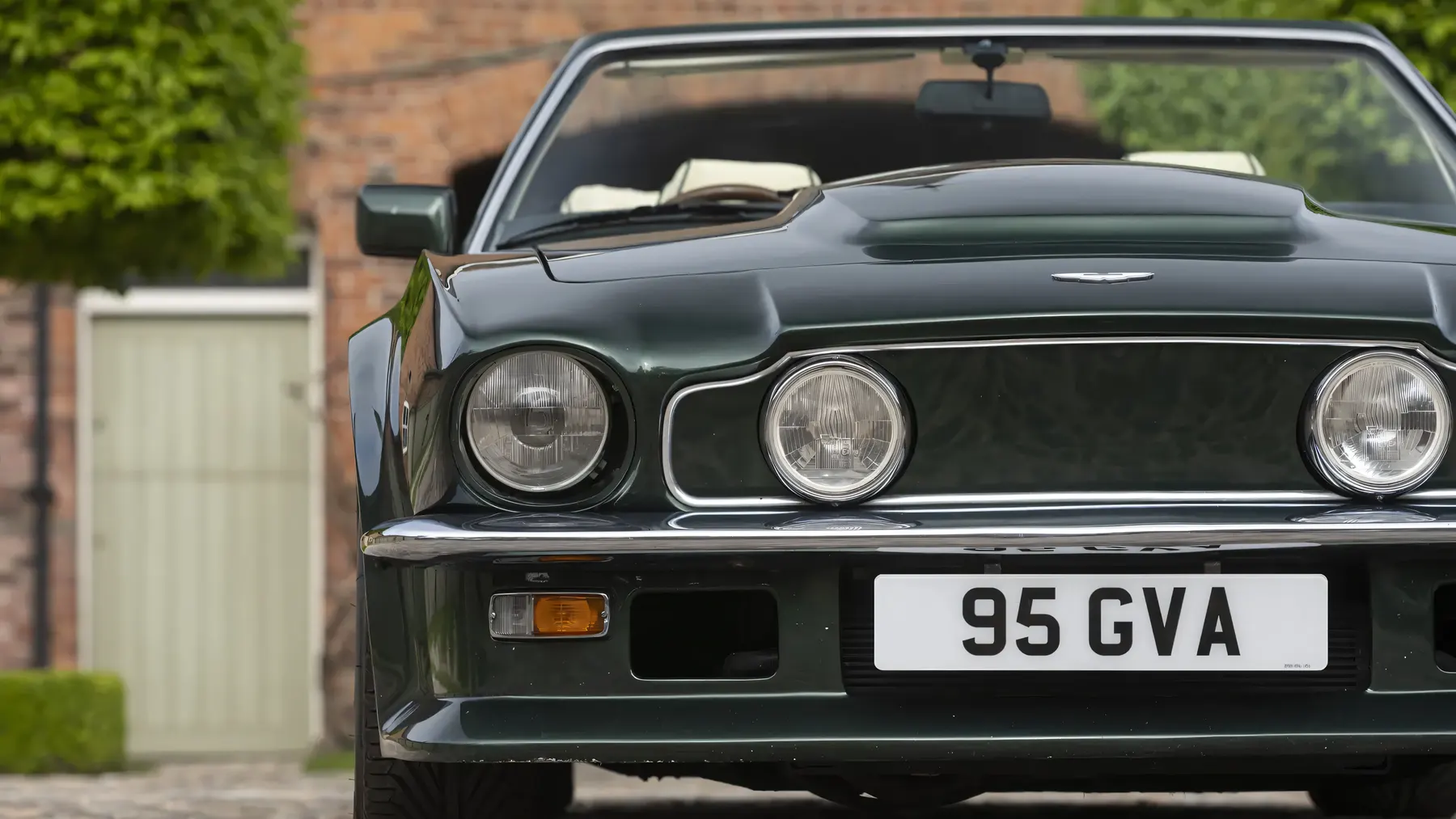
Visually, the X-Pack Volante wears its 1980s aggression without apology. The outrageously flared wheel arches, the deep front splitter, the rear flick spoiler and the distinctive bonnet bulge combine to give a car that is, objectively speaking, not subtle. The 16-inch Ronal alloys with their concealed wheel bolts sit perfectly within those arches, offering a contemporary visual anchor to bodywork that was otherwise rooted in William Towns’ original DBS design language from a decade earlier. The body first appeared on the six-cylinder DBS in 1967, making the X-Pack Volante’s lines roughly twenty years old by the time the last car rolled off the line in 1989. This is either a testament to timeless design or an acknowledgement of Newport Pagnell’s limited development budget, depending on your disposition — though it bears noting that the Italians were also squeezing considerable longevity from their own classic shapes during this period.
Drop into the driver’s seat and the interior experience is a study in glorious contradiction. Connolly leather covers everything the eye can find — seats, dash top, centre console — while real wood trim runs across the fascia in the manner of an Edwardian gentlemen’s club. The instruments are clear and purposeful, the driving position well-considered. And then you twist the key and the cabin fills with a sound that has absolutely no business being this good from an engine designed in the early 1960s — a deep, resonant V8 growl that seems to come from somewhere geological rather than mechanical. With the Volante’s hood lowered, that soundtrack is entirely unfiltered, the top half of the car no longer mediating between driver and engine. It is, by any honest measure, one of the finer sensory experiences available from the era. The five-speed ZF manual is smooth and accurate in operation, and the clutch — contrary to what the engine’s considerable torque might suggest — is reported to be light and progressive rather than a physical ordeal.
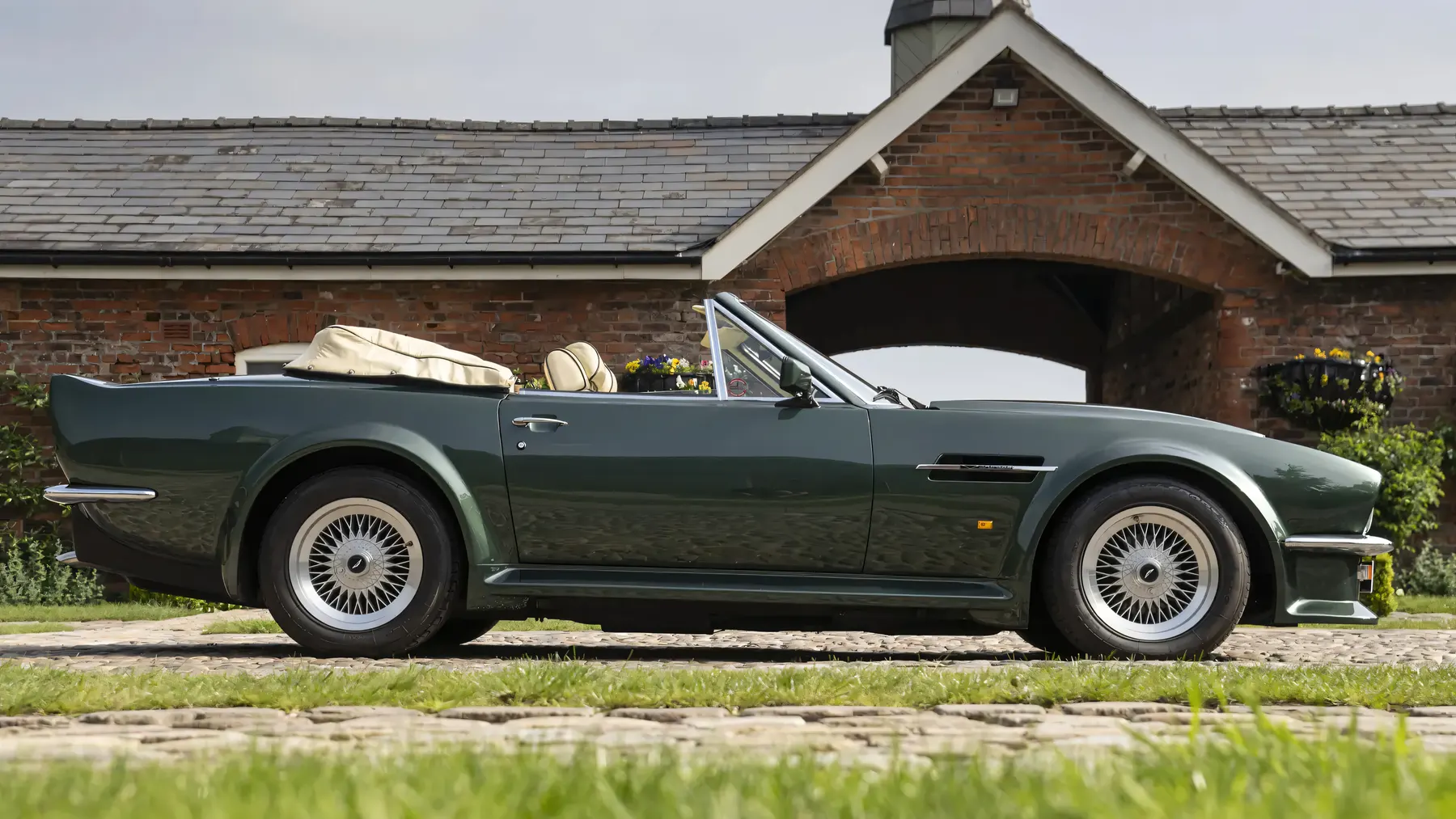
On the road, the X-Pack Volante delivers its performance in a manner that is simultaneously exhilarating and entirely honest about what it is. The power is prodigious and seemingly inexhaustible — accelerate hard in fourth or fifth and the car still builds speed at a rate that would embarrass most contemporary machinery in first and second. The steering is power-assisted, accurate and well-weighted, enabling a driver who respects the car’s mass to guide it with real confidence. That mass, though, is never entirely absent from the conversation. The X-Pack Volante is not a car that pretends to be light; its bulk and size are always present through the bends, and the Zagato-derived suspension — stiffer than earlier Vantages, offering improved composure without sacrificing the ride quality that the GT brief demands — can do only so much. At high speed on open roads, the car is magnificent. In tight, technical driving, it asks for patience and respect in return for its cooperation.
The genuine innovations here deserve proper acknowledgement. The X-Pack engine specification was a masterclass in extracting maximum performance from an existing architecture without compromising either reliability or driveability — no small achievement when you’re chasing figures north of 400 bhp from carburettors and iron engineering discipline. The fact that each car required 1,200 man-hours of handwork to complete meant that every X-Pack Volante was, in a meaningful sense, an individual object. Newport Pagnell’s craftsmen built these cars in ways that mass-production facilities cannot replicate, and the quality of the finished product — the leather, the timber, the fit of the hood — reflected that investment of human attention in ways that have only appreciated in retrospect.
The compromises are real, however, and pretending otherwise would be a disservice. The body design’s age was not merely an aesthetic consideration; aerodynamic development had moved on considerably since William Towns conceived those lines, and the X-Pack’s on-paper performance advantage over rivals was meaningfully eroded at higher speeds by a drag coefficient that modern standards would consider generous. The interior, for all its luxurious appointments, was not especially spacious — the bulk of the exterior does not translate into palatial accommodation inside — and the rear seats were best suited to children or luggage rather than adults on any journey of meaningful duration. Visibility from the driver’s seat presented its own challenges, a consequence of the relatively high seat belt position and the car’s considerable overall height. And the three-speed automatic option, offered from 1987 onwards, was a Chrysler Torqueflite unit that, while robust, felt mismatched to an engine of this calibre — though only 79 of the 167 Volantes were delivered with the five-speed manual anyway, which somewhat focuses the mind about what the majority of early customers were actually prioritising.
Culturally, the V8 Vantage X-Pack occupies a specific and irreplaceable position in British automotive history. This was the car that Newport Pagnell sent out as its final word on a formula it had been perfecting since the late 1960s, a handbuilt, front-engined, naturally aspirated V8 grand tourer that refused to genuflect to the era’s growing obsession with turbocharged performance and technology-first engineering. The Virage that replaced it in 1989 was a more contemporary machine in almost every respect, but in the transition something intangible was lost — the sense of an unbroken thread stretching back through a lineage of decisions made by small groups of dedicated engineers in a Buckinghamshire town. The X-Pack was also significant in the Zagato context: the 432 bhp Works Service specification directly mirrored the Zagato’s engine, meaning that the production Vantage had effectively caught up with its exclusive, coachbuilt sibling on the most important measure.
The reception, both at launch and in the decades since, has been consistently warm among those who understand what they are dealing with. Period road tests were impressed by the performance and the refinement of the cabin, though most noted the car’s fundamental character as a fast GT rather than a sports car in the purest sense. The PistonHeads community has been vocally appreciative, with the X-Pack specification regularly cited as the most desirable iteration of the first-generation Vantage, and the Volante adding an additional premium for its combination of open-air driving and genuine performance. Aston Martin’s own retrospective assessment describes the later 580 X-Pack versions as “particularly sought after,” which, from a manufacturer’s official history page, represents about as close to an enthusiastic endorsement as institutional restraint permits.
What Newport Pagnell ultimately built in the X-Pack Volante was something that no spreadsheet could have justified and no modern development process would have sanctioned: a convertible supercar assembled largely by hand, powered by a four-decade-old engine design that had been coaxed and cajoled into producing figures that contemporary turbocharged rivals could barely match, and finished to a standard of interior craftsmanship that positioned it as equally at home on a country estate as at a racing circuit. It was commercially impractical, technically anachronistic, and entirely magnificent — which, in 1989 as much as today, is rather the point of an Aston Martin.
Related Notes
- Aston Martin DB Vantage
- Tadek Marek and the Engine That Built Aston Martin
- The 1980s Supercar era
- William Towns Bodywork