1966 Ferrari 275 GTB-6C by Scaglietti
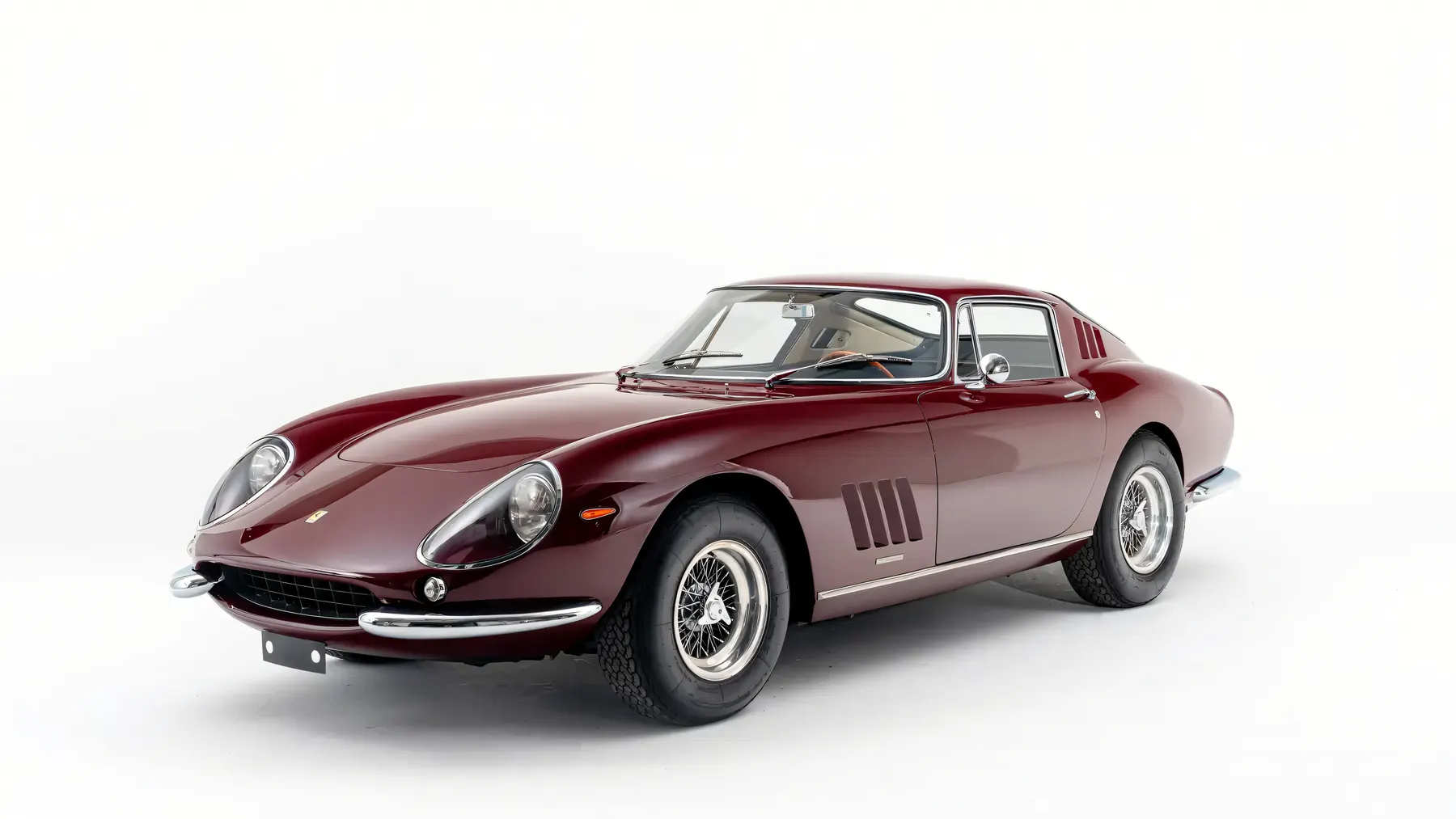
Six carburettors. For most road car engineers in 1964, that would have been an act of provocation. For Ferrari, it was simply an acknowledgment of what the engine already wanted to be - a racing unit barely disguised behind a steel body, politely agreeing to sit in traffic occasionally, but fundamentally unwilling to pretend it had been built for anything less than full throttle.
The 275 GTB made its debut at the October 1964 Paris Auto Salon, announced alongside the open 275 GTS, and in one stroke it rendered its predecessor - the revered 250 GT lineage - somewhat historical. The name followed Ferrari’s established convention: 275 referred to the swept volume of each individual cylinder, twelve of them arranged at 60 degrees, displacing a combined 3,285.72cc. But the real news wasn’t the engine displacement - it was everything below and behind the engine. The 275 GTB was the first Ferrari road car to feature both a rear-mounted transaxle and fully independent suspension at all four corners. Ferrari’s racing engineers had been using transaxle layouts on competition machinery for years, and the knowledge bled directly into the 275’s architecture, placing the five-speed gearbox and rear differential together in a single unit that dramatically improved front-to-rear weight balance.
Within the 275 GTB family, the variant hierarchy matters enormously and the six-carburetor specification - the /6C - sits at the apex of the single-cam cars. The model evolved visibly during its production run. Early cars wore what is now called the “short nose” - a tighter, arguably more elegant front-end profile that, unfortunately, generated unwanted aerodynamic lift at speed. Ferrari engineers, drawing on their motorsport experience, stretched the nose in 1966 to address this directly, creating the “long nose” second-series car that simultaneously received another crucial mechanical fix: the torque tube. Where the original driveshaft arrangement transmitted considerable stress through its central support bearing, the torque tube enclosed the shaft within a rigid tube connecting engine and transaxle, smoothing torque delivery and substantially reducing drivetrain vibration. Approximately 206 long-nose cars were built before production ended, representing a numerically small production run even by Ferrari’s period standards.
The heart of it all is the Tipo 213 - Ferrari’s final and most developed iteration of Gioacchino Colombo’s legendary short-block V12 architecture. In standard three-carburetor form, the engine produced around 280 horsepower at 7,600 rpm. Specify the six Weber 40 DCN carburettors - each of the six cylinders per bank now fed by its own dedicated instrument - and power climbed to approximately 300 horsepower. That extra 20 horsepower matters less on paper than it does in character: the six-carb setup transforms the engine’s intake note into something almost orchestral, six hungry throats opening simultaneously from 5,000 rpm to the rev limit in a crescendo that few contemporary road cars could match or have matched since. Total weight sat around 1,200 kilograms, and the sprint from rest to 60 mph occupied roughly 6.3 seconds - quick enough in 1966, when most competitors weren’t within several technical generations of what Ferrari had assembled here.
Pininfarina penned the body, and Scaglietti built it - a creative collaboration that produced one of the defining shapes of its decade. The long nose’s proportions are different from the short-nose cars: slightly more aggressive, a touch more purposeful, with the lengthened hood line giving the car an insistent forward lean even at rest. The Kamm-influenced fastback roofline flows into a truncated tail with real aerodynamic reasoning behind it. The greenhouse is tight, framed by slim pillars that would make a modern safety engineer wince but which give the driver an almost panoramic view of the road ahead. Inside, the cockpit is purposeful rather than sumptuous - leather-trimmed, certainly, but the placement of the instrumentation, the gate of the gearshift, and the thin-rimmed wood-and-aluminum steering wheel all signal where priorities truly lay.
The driving experience is where the 275 GTB/6C distinguishes itself from being merely a beautiful artifact and earns its reputation as a genuinely great driving machine. Classic Driver’s assessment remains apt: the steering, unassisted and not rack-and-pinion, allows the car to be “thought” through corners with a quality of feedback that most modern cars have engineered away entirely. The transaxle-mounted gearbox contributes to handling that feels balanced in a way the front-heavy 250 series could never fully achieve. Steve McQueen, who knew his way around a quick automobile, described the action of the five-speed as “like sliding a knife through butter” - and by the accounts of those who have driven well-sorted examples, that comparison still holds.
What the /6C configuration particularly rewards is commitment. The six Webers don’t idle with the docility of a car built for urban errands; they require the engine to be warm and the driver to be engaged. Below 3,000 rpm, the car is cooperative but slightly aloof. Above 5,000 rpm, everything changes, and the engine’s dual personality resolves itself entirely in favour of the latter, racing identity. The five-speed gearchange, when the drivetrain is in the torque-tube long-nose configuration, is notably more refined than in the earliest cars, the vibration that plagued early examples substantially damped.
The GTB’s competition credentials are real, not retrospective. The 275 GTB/C - a direct derivative of the long-nose car entrusted to chief engineer Mauro Forghieri - ran at Le Mans and across the 1966 GT season, relying on the same Tipo 213 block, now with competition-specification internals: forged pistons, lightened connecting rods, Nimonic steel valves filled with sodium for thermal management. In an ironic footnote, Ferrari had forgotten to include the six-carburetor option in the /C’s official homologation papers, meaning the competition car was required to run three carburettors despite the road car offering six - a bureaucratic oversight that quietly confirmed just how racing-oriented the /6C specification always was.
No honest account of the 275 GTB should pass over its shortcomings. The cabin is cramped by any generous measure, and visibility to the rear is limited. The short-nose cars, as delivered, were genuinely unstable at high speed - an aerodynamic oversight that required a body redesign to correct. The torque tube, for all its mechanical elegance, arrived mid-production rather than from the beginning, meaning early buyers discovered the problem through ownership rather than specification sheets. And the six-carburetor setup, magnificent in full song, demands careful and regular tuning to remain in balance - these are not low-maintenance instruments, and an improperly tuned set of six Webers makes the engine’s character fractious rather than exhilarating.
The 275 GTB/4, which arrived in 1966 with twin overhead camshafts per bank and a standardized six-carburetor setup producing 300 horsepower, is often considered the definitive version of the model - and in terms of sheer technical sophistication, it is. But the /4 also represented a step toward greater mechanical complexity, and the raw, visceral quality of the single-cam six-carburetor engine has its own constituency of admirers who find the /4’s smooth competence slightly less arresting than the /6C’s barely contained energy.
The cultural footprint of the 275 GTB extends well beyond auction results and concours trophies. It occupies a specific and irreplaceable position in Ferrari’s history - the car that proved the company could translate genuine racing technology into a road machine without fatally compromising either the race car’s integrity or the road car’s usability. Period road testers recognized this immediately, and the critical consensus from those early years has only solidified with time. It remains a car that serious collectors, serious drivers, and serious historians of the automobile agree on - which is rarer than it sounds in a field prone to revisionism and fashion.
What makes the long-nose /6C with torque tube the summit of the single-cam 275 hierarchy is precisely its combination of resolved engineering and unresolved temperament. Every mechanical issue that afflicted the early cars has been addressed. The aerodynamics work. The drivetrain is cohesive. But the engine - that glorious, demanding, six-throated Tipo 213 - never became polished enough to lose the quality that made it worth building in the first place. It still asks something of the driver, still requires attention and skill and a willingness to use the rev range properly. In that sense, the 275 GTB/6C is less a product of its era than a direct line to what Ferrari has always, at its best, tried to make: a car that considers driving an act worth taking seriously.